
• Skip to primary navigation
  • Skip to main content

Nautilus Nautilus logo

  • About
  • Services
  • FAQs
  • Contact
CALL NOW 561-637-4242 Available 24/7
  • About
  • Services
  • FAQs
  • Contact
  • CALL US (561) 637-4242

Uncategorized

How In-Home Care Improves Quality of Life for Seniors

​Aging brings many changes in people’s lives. Reduced mobility can make everyday routines more difficult. Every person needs dignity, independence, and meaningful connection.​

When seniors need help, families look for ways to provide support without taking away comfort. They want their loved one to maintain the identity built over a lifetime. For many, home care is more than a service. It is a way to improve the quality of life.

​In-home care allows support to be shaped around their personal routines and preferences. The comfort and familiarity cannot be replicated in a clinical setting.

Key Takeaways Explanation
Independence Matters Seniors maintain control over daily decisions and routines
Home Environment Heals Familiar surroundings reduce stress and confusion
Flexible Care Plans Care evolves with changing needs
Companionship Is Essential Reduces loneliness and supports mental health
Supports Families Too Relieves stress and prevents caregiver burnout

​

Maintaining Independence Without Compromising Safety with In-Home Care

One of the biggest fears for seniors is losing their independence. Moving into a care facility is seen as giving up control. They no longer maintain their own routines and must follow set schedules. On the other hand, seniors may miss seeing the familiar faces of people they trust.

​Home care provides a different experience. The support is introduced gradually at their own pace. It doesn’t disrupt their daily routines and habits. The caregiver provides as much assistance as needed, while still encouraging independence.

​They assist with personal care such as dressing, bathing, or meal preparation. But the senior still makes the decisions. They decide when to wake up, what to eat, or how to spend the afternoon. The sense of choice helps reinforce identity, something that isn’t available in a clinical setting.

​From a professional standpoint, too much assistance can lead to dependency. However, too little support can be unsafe. The key is to achieve the right balance. Caregivers are trained to encourage participation, but assist if safety is compromised. They can help a senior get dressed, but let them button their shirt.

​For example, a senior with mild mobility issues still wants to cook their favorite meal. The caregiver doesn’t take over entirely. They handle tasks that involve heat or heavy lifting, which are safety risks. The senior chops the vegetables and follows the recipe. This isn’t just a meal for them, but a sense of independence.

Area of Impact How In-Home Care Helps Key Benefit
Independence Supports daily activities while allowing personal choice Maintains control over routines
Emotional Well-Being Familiar environment reduces stress and anxiety Improves mood and mental health
Personalized Care Care plans adapt as needs change Flexible and responsive support
Companionship Provides meaningful social interaction Reduces loneliness and isolation
Physical Health Encourages medication adherence, nutrition, and activity Supports overall health stability
Family Support Relieves caregiver burden Prevents burnout
Dignity Respects preferences and privacy Preserves identity
Stability Maintains familiar routines and surroundings Enhances long-term well-being

​

The Emotional Impact of Staying in a Familiar Environment

Seniors feel calmer in their own homes. The photos, furniture, and their porch carry memories. The familiarity feels grounding, especially for seniors with cognitive decline.

​Moving to a new environment can make them feel confused, anxious, and depressed. Besides that, it can worsen symptoms for individuals with dementia.

​Home care keeps the environment constant. Families often notice the change when shifting from institutional to home care. Seniors who seemed withdrawn become talkative. Sleeping is improved, and agitation decreases.

​While the familiar space is important, caregivers also do their best to build trust. They learn personal preferences and routines to create meaningful connections. Preparing a meal tied to family traditions can help establish a strong bond.

​

Personalized Care That Adapts to Changing Needs Over Time

Seniors’ needs do not stay the same. In-home care is flexible and adapts to the changes. The care plan can evolve as needed, in coordination with the family.

​A senior who is still independent may start with a few hours of care weekly. They receive help with errands, light housekeeping, or companionship. As their health declines, the care plan reflects that. More hours may be added to the schedule. Support can also expand to include daily visits, medication management, or mobility assistance.

​The caregiver monitors the senior’s health. They can spot early signs of physical and cognitive decline.

​For example, a caregiver took a client for morning walks. The senior started skipping them in the usual routine. The caregiver notices the change and shares this with the family so they can schedule medical checks. The observation helps detect issues early and prevent more serious complications.

​

Reducing Loneliness Through Meaningful Connection

Loneliness is one of the least visible challenges, but it affects seniors significantly. They need meaningful interaction to fight isolation. Otherwise, this can affect mental health, cognitive function, and even physical well-being.

​The caregiver is not only there to cook a meal or tidy the house. They also provide companionship and human connection. They spark meaningful conversations and watch TV together. Having someone present makes a huge difference.

​Companionship doesn’t replace family relationships. But it fills the gaps. Family members may live in another state. Or they have demanding schedules, juggling full-time jobs and personal responsibilities. For them, knowing that someone is present when they’re not provides emotional relief.

​Real-life examples confirm the impact. A senior spent most of their day watching TV. With encouragement from their caregiver, they started engaging in their favorite hobbies again. Light exercise, gardening, and reading became part of their everyday routine.

​Caregiver matching is an important aspect of companionship. Matching caregivers based on personality and shared interests is important.

​

Supporting Physical Health

Physical health is supported through daily habits. For example, this includes taking medication correctly, eating balanced meals, staying active, and recognizing early warning signs.

​In-home caregivers help maintain these routines. They remind seniors to take their medication on time. As part of their duties, they do grocery shopping and prepare balanced meals. Plus, caregivers encourage light movement appropriate to the senior’s abilities.

​

Providing Relief for Family Caregivers

Families often take over the role of caregivers out of love. But it can be overwhelming. Balancing work, personal responsibilities, and caregiving can lead to burnout and stress.

​Home care offers a helping hand for family members who need it. It doesn’t mean stepping away entirely. Instead, it means sharing responsibility. Family members can focus on the emotional support, while the caregiver does the practical tasks. These moments of relief give family members time to rest or manage their own responsibilities.

​Professional caregivers also bring expertise that families may not have. They are trained in safe transfer techniques and know how to recognize health warning signs. Plus, they know how to handle resistance to care or mood changes.

​The combination of family caregiving and in-home care is important for long-term sustainability.

​

Preserving Dignity Through Respectful Care

Dignity is preserved with small steps. The caregiver involves seniors in decisions. They handle personal care tasks respectfully.

​In-home care allows for a personalized approach that focuses on the senior’s preferences. Care is delivered in their own home, which eliminates the need for adaptation.

​The caregiver prioritizes the client’s preferences. They learn how the seniors like coffee or how they want their home to be organized. This helps them maintain a sense of identity.

​Even when needs get more complex, maintaining dignity is important. Caregivers explain each step during the personal care routine and respect privacy. These are the small things that make them feel respected.

​

Creating a Sense of Stability

Change is very difficult for seniors. As people age, they find comfort in stability. It is not only about helping with chores. Home care is about waking up in their own bed and enjoying their garden. Getting the support they need while remaining true to themselves is one of the most important aspects.

​Even if the needs increase, daily life remains the same. Seniors go to sleep in the same bed. They see the same familiar faces. The home still feels like home. This stability improves both physical health and emotional well-being in the long term.

​

Preserving Daily Life

In-home care helps preserve the senior’s personal rhythm. In care facilities, the day follows a fixed schedule. The meals are served at set hours, and lights are turned off at a certain time. The group activities also have a timetable.

​The day feels structured, but not personal. At home, the time is flexible. The seniors can eat breakfast later. They can watch their favorite show without interruption. And they can sit quietly with their thoughts without being rushed to the next activity.

​The truth is that seniors have shaped their daily routine over decades. In-home caregivers respect their routines and work at their natural pace.

​For instance, a retired teacher spent her life waking up early and enjoying slow mornings with a cup of coffee. In a facility, she may be expected to join breakfast at a fixed hour surrounded by noise.

​At home, her caregiver lets her keep her usual routine. They help with preparing coffee and ensuring the medications are taken.

​

Final Take

Home care is about preserving independence, comfort, and dignity. Through everyday interactions, caregivers place a strong focus on these values. When done thoughtfully, home care helps seniors live on their own terms instead of feeling managed.

​Choosing in-home care may be a sensitive topic for many. We understand that your situation requires a professional approach. Contact our in-home care agency now, and we will help you find the best option.

Question Answer
How does in-home care improve independence? It supports tasks while allowing seniors to make their own decisions
Does home care help with loneliness? Yes, caregivers provide companionship and meaningful interaction
Can care plans change over time? Yes, they adapt as the senior’s needs evolve
How does it support physical health? Through medication reminders, nutrition, and activity support
Does in-home care help families? Yes, it reduces caregiver stress and provides professional support

​

Is In-Home Care Tax Deductible?

​When considering home care, families have so many worries. Cost is one of the most important topics for discussion. In-home care is one of the lines in your budget. Families often look for ways to reduce the cost, and they ask: Is in-home care tax-deductible?

​The truth is that some costs are deductible, and others are not. This guide reveals everything you need to know, starting from what’s deductible and what isn’t.

Key Takeaways Explanation
Partial Deductibility Only medically necessary portions qualify
Strict IRS Rules Must itemize and exceed 7.5% AGI threshold
Documentation Is Critical Invoices, payments, and care plans support deductions
Insurance Reduces Deduction Only out-of-pocket costs can be claimed
Hidden Opportunities Home modifications and payroll taxes may qualify

​

Is In-Home Care Tax Deductible?

In-home care is tax-deductible if it qualifies as a medical expense under rules set by the Internal Revenue Service. This includes medical care services such as nursing, medication management, therapy, and help with daily activities due to illness. However, non-medical services are not eligible. This includes housekeeping, errands, and companionship.

​The IRS has strict guidelines that define what is deductible and what isn’t. In-home care is tax-deductible if it is considered medically necessary. But there are some rules that determine eligibility. First, you must itemize your deductions. Also, medical expenses must exceed 7.5% of your income.

Category Details Key Notes
Tax Deductibility Allowed if classified as medical expense Must meet IRS requirements
Eligibility Rule Must itemize deductions Schedule A required
Income Threshold Expenses must exceed 7.5% of AGI Only excess amount is deductible
Qualified Person Spouse, dependent, or self Must provide >50% support
Deductible Services Nursing, therapy, ADL assistance Must be medically necessary
Non-Deductible Services Housekeeping, errands, companionship Non-medical tasks excluded
Documentation Invoices, proof of payment, care plan Required for IRS validation
Insurance Impact Only out-of-pocket costs qualify Reimbursements not deductible
Additional Deductions Home modifications, caregiver payroll taxes Must be medically necessary

​

1. You Must Itemize Your Deductions

According to the IRS, in-home care costs can be deducted if you itemize deductions on your tax return (Schedule A), instead of taking the standard deduction.

​

2. Expenses Must Exceed 7.5% of Your Income

According to the IRS, you can only deduct the portion of medical expenses that exceeds 7.5% of your adjusted gross income (AGI). This means the full amount cannot be deducted. Actually, this is where many people get surprised.

​For example, your income is $60,000. The 7.5% threshold here would be $4,500.

​If medical expenses are $10,000, you can only deduct $5,500. As a result, this rule may limit deductions for moderate care costs.

​

3. The Person Must Qualify

You can deduct expenses if the person receiving care is your spouse or dependent and you pay for more than half of their support.

​Seniors can claim deductions on their own taxes when they pay for their care.

​Chronically ill patients may be able to deduct personal care and household maintenance. The conditions that determine eligibility are: the person has severe cognitive impairment or loss of functional capacity.

​What Counts as Deductible In-Home Care?

​Deductible

  • Skilled nursing care at home
  • Medication administration
  • Physical therapy or rehabilitation
  • Help with activities of daily living

​Activities of daily living (ADLs) can be deducted if they meet the IRS criteria. A doctor should certify that the individual requires substantial supervision due to severe cognitive impairment, or they require assistance with at least two ADLs for a minimum of 90 days.

​Not Deductible

  • General housekeeping
  • Cooking (unless tied directly to medical care)
  • Companionship or supervision
  • Errands or transportation not related to treatment

​For example, a caregiver provides both types of support. They help with medication administration and do housekeeping. In that case, only the medical portion counts. The cost is $500 per week and 10% of the work is housekeeping. This means that $450 will be deducted, as the remaining $50 is for non deductible activity.

​

How to Document In-Home Care Expenses

The line between medical and non-medical services isn’t always clear. That’s why in-home deductions are closely reviewed. For you, this means gathering the needed documentation. Otherwise, even the valid expenses may be denied.

​Make sure to keep records as soon as care begins. Home care agencies provide detailed invoices for the services provided. This helps separate medical and non-medical tasks, which is needed to justify the expenses.

​Proof of payment is another important thing to include in your record. Bank transfers and card statements are a must in case the IRS requests verification.

​A written care plan is also nice to have. It doesn’t need to be anything too complex, but explain why care is needed. A note from a doctor can be included stating the need for assistance.

​

How Insurance and Other Benefits Affect Your Tax Deduction

Long-term care insurance is one of the ways to cover home care. But remember that the IRS only allows deductions for out-of-pocket expenses.

​For those using long-term care, the amount covered by the policy is not deductible. For example, care costs $4,000, and insurance covers $2,500. You cover the remaining $1,500. In that case, you can only deduct the $1,500.

​The same applies to any type of reimbursement. When costs are covered by private insurance, government programs, or employer-sponsored benefits, they can’t be claimed as a deduction.

​

Additional Ways Families Can Deduct the Cost of In-Home Care on Taxes

When people think of tax deduction, they focus only on the obvious services such as nursing, bathing, and medication help. But there are some less obvious ways to do it.

​

Hiring a Caregiver Directly

When families choose to hire a caregiver, they have two options. One of them is hiring privately, and the second one is going through an agency. When the family hires a private caregiver, this legally fails under a household employee arrangement. 

When you pay taxes as an employer, you can deduct some of those. If the care is medically necessary, some of the payroll taxes may be included as part of your medical expenses.

​While there are some tax deduction opportunities, many families avoid hiring a private caregiver. They do this because of the drawbacks, such as doing the administrative work and having no backup in case of sick leave. In addition to administrative tasks, the home care agency is responsible for caregiver matching, care plans, and replacements.

​

Making the Home Safer

Home care often includes adapting the space. The caregiver may suggest changes that improve safety and accessibility. According to the IRS, medically necessary modifications qualify for a tax deduction. It is not accepted if it increases the property value.

​Examples:

  • Installing ramps for easier entry
  • Widening doorways to accommodate walkers or wheelchairs
  • Adding grab bars in bathrooms or along hallways

​

One family installed a wheelchair ramp and bathroom grab bars after their mother had a stroke. These modifications are tied to mobility and safety, so they qualify as medical expenses and can be deducted from the tax.

​

Getting Help With the Tax Side of In-Home Care

Now you understand the basics and know which portion of the cost of in-home care is tax-deductible. But you also know that handling taxes can be challenging. The line between medical and non-medical services isn’t always clear. And details in the documentation can change what you’re allowed to deduct.

​Families often turn to tax professionals for help. They not only help with paperwork but also interpret the rules for you. They can review whether your expenses are eligible for tax deduction. Plus, they can clearly separate deductible and non-deductible portions of the total cost.

​Tax professionals also find overlooked opportunities, like the home modifications we explained earlier. And they document everything for an audit.

​

The Role of Home Care Agencies

Reputable home care agencies can help you in the process. Although their assistance may be limited, it is still valuable. You need to track the expenses and keep records, and the agency needs to provide clear documentation.

​Your agency creates detailed invoices that break down the services provided. They clearly outline services, which can support medical necessity. The payment records are also included in your files.

​Reputable agencies provide general guidance based on their experience. They can also recommend relevant resources.

​

Why In-Home Care Is Still Worth It

When looking for home care, families often focus on the cost and tax deductions. But don’t forget to consider the real value and long-term benefits.

​Your loved one stays in a familiar environment, which reduces stress and anxiety. They keep their daily routines and independence, which has a positive impact on their emotional well-being.

​For families, in-home care provides peace of mind. The caregiver ensures a safe environment and that medications are taken correctly. They provide assistance during the riskiest tasks, such as cooking and showering. This helps keep the senior’s health stable and avoid hospital stays.

​

Final Take

After going through our guide,you can clearly understand what is deductible and what is not. Consult with a tax professional to understand more about how the rules apply to your specific situation.

​As a reliable provider, we will do the best we can to ease the process. Contact us now!

Question Answer
Is all in-home care tax deductible? No, only medically necessary services qualify
Do I need to itemize deductions? Yes, itemizing is required to claim these expenses
What is the 7.5% rule? Only expenses exceeding 7.5% of your income are deductible
Can I deduct expenses covered by insurance? No, only out-of-pocket costs qualify
Are home modifications deductible? Yes, if medically necessary and not increasing property value

What Is Hospice Care in Home

​Hospice care at home is a type of care for people with terminal illnesses. It is meant to provide comfort-focused care for patients in their homes. Instead of receiving care at a facility, the patient remains in a familiar environment.

​Instead of treatment, the focus is on comfort, controlling symptoms, and maintaining dignity. When a doctor determines treatment is no longer effective, the focus should shift to comfort. The service is provided by a specialized team that supports both the patient and their family. The goal is to prevent unnecessary hospitalizations that put stress on the patient.

Key Takeaways Explanation
Comfort Over Cure Hospice prioritizes symptom relief and dignity instead of treatment
Family-Centered Care Family members play a central caregiving role with professional support
Multidisciplinary Support Teams include medical, emotional, and spiritual care providers
Not Full-Time Care Care is scheduled, not continuous; families remain primary caregivers
Improved Quality of Life Patients experience more comfort and meaningful time at home

​

Hospice Care in Home​

Hospice care focuses on the quality of life. The treatments for curing an illness may no longer be effective. Hospice care ensures that the time that remains is as comfortable as possible. Experienced caregivers help relieve physical discomfort. They also address emotional, psychological, and spiritual needs.

​Many people assume hospice care is only for the final days of life. But it can start earlier. In many cases, it begins when a doctor estimates a person may have six months or less to live. This helps provide comfort and reduce unnecessary hospital visits.

Category Details Key Notes
Purpose Comfort-focused care for terminal illness Focus shifts from cure to quality of life
Location Patient’s home, family home, or care facility Familiar environment improves comfort
Care Team Nurses, doctors, aides, social workers, counselors Multidisciplinary support system
Primary Caregiver Family member or close friend Main day-to-day support role
Services Provided Pain management, medication, equipment, emotional support Customized care plans
Excluded Services Curative treatment, full-time care Focus strictly on comfort
Availability Scheduled visits + 24/7 on-call support Not continuous presence
Benefits Comfort, control, meaningful time with loved ones Improves emotional well-being

​

What Does Hospice Care at Home Look Like?

Hospice care at home is provided by a specialized team of healthcare professionals. They help the patient and their family during difficult times. It provides professional care in a familiar environment where patients feel most comfortable. The team visits regularly and is available 24/7 for urgent needs.

​However, it is important to note that the patient’s home can be their private residence, a family member’s home, or a care facility. Any of these can be considered “home” for hospice purposes.

​

Who Is Involved in Hospice Care at Home?

Hospice care is provided by a multidisciplinary team. Every member has a distinct role. Together, they work to provide support.

​

Primary caregiver

The primary caregiver has an important role in the process. It is a family member or a close friend of the patient. They work closely with the hospice care team to develop a care plan. They make decisions, keep track of symptoms, and communicate with the caregivers.

​The hospice team guides and assists, but the family is always present. Because of this, it can be overwhelming for the family members. The team helps with clear communication and support.

​

Nurses

Hospice nurses monitor the patient’s condition, manage symptoms, and administer medications. They also educate the family members, explaining medical information in a way they can understand. They teach them how to recognize warning signs and to respond to discomfort.

In a case of an emergency, the nurse is the first point of contact for the family.

​

Doctors

Physicians adjust the care plan and medications based on the symptoms. They work closely with the nurses to make the adjustments. Plus, doctors update medications to help relieve discomfort without causing side effects.

​

Home Health Aides

While doctors and nurses provide medical services, home health aides help with daily routines. They assist with bathing, dressing, grooming, and mobility. These tasks may look basic, but they are important for maintaining dignity and comfort.

​Family members often manage the basic tasks. But as care becomes more demanding, they can feel overwhelmed. Home health aides offer a helping hand to family members.

​

Social Workers

Social workers help families navigate the process. They provide emotional support and practical guidance. They provide a comfortable space where families can process the situation in their own way.

​They also connect families with resources and financial support systems.

​

Spiritual Counselors

Spiritual counselors help patients understand the changes and support them in finding meaning, belief, and emotional peace. However, this isn’t religious guidance. For many people, it is an opportunity to reflect or find a sense of closure.

​In fact, spiritual support is always optional. Plus, it is adjusted to the patient’s preferences.

​

What Services Are Provided?

Hospice care at home includes a wide range of services. Each care plan is adjusted to the individual’s needs.

​

Pain and Symptom Management

Hospice care focuses on relieving discomfort. Pain and other symptoms such as fatigue, nausea, and shortness of breath are often present. The hospice team works with the primary caregiver to develop a plan and readjust it as needed. The goal is to reduce suffering while maintaining as much alertness as possible.

​

Medication Management

Hospice teams provide and manage medications. They advise families on how to administer them safely.

​

Medical Equipment

Hospice care at home also provides medical equipment. They deliver it to the home to ensure a safer and more comfortable environment. The equipment includes hospital beds, oxygen supplies, and wheelchairs or walkers.

​

Personal Care Support

As mobility declines, the usual everyday tasks are more challenging. Hospice aides help with personal care such as bathing, dressing, grooming, and mobility.

​

Emotional Support

End of life brings complex emotions, both for the patient and the family members. Emotional support is part of the hospice care at home, providing counseling and guidance.

​

Caregiver Support

Family members are the main caregivers. So they may feel overwhelmed with the situation. The hospice team provides education, reassurance, and respite care so the family can rest.

​

Bereavement Support

The support does not end after the patient has passed. The hospice programs provide follow-up support for families and grief counseling.

​

What Doesn’t Hospice Care Provide?

Hospice care provides a wide range of services to support the patient and their family. Yet, it is important to understand which services are included. This helps families set realistic expectations.

​

Curative Care

Hospice care at home comes when curative treatments no longer help. So the focus shifts to comfort. It does not provide treatment for healing an illness or slowing the progression.

​The change is difficult for families. But they should know that every decision in hospice care is evaluated based on whether it improves comfort.

​

Continuous In-Home Medical Presence

One of the common misunderstandings about hospice care at home is that it provides continuous presence. The truth is that the hospice team visits regularly, but is not present all the time.

​The care plan has a schedule that the team follows. And yes, they are available on call for urgent situations. However, the family members are still the primary caregivers. The hospice care at home has a strong focus on educating and preparing them for this.

​

Full-Time Caregiving Support

Hospice care at home does not provide full-time support. Families are responsible for most of the personal care, such as meals, routines, and medication supervision.

​We understand that this situation can be challenging for families. That’s why many get additional in-home care services to align with hospice care. In-home care can take over personal care, light housekeeping, and mobility, and is available as needed. Families can adjust the schedule accordingly.

​

A Completely Stress-Free Experience

Hospice care provides support, comfort, and guidance. While it helps a lot, families will still feel the emotional weight. They can experience stress and uncertainty. Hospice care at home provides guidance and education, so families can manage stress and continue with more clarity.

​

Benefits of Hospice Care at Home

Hospice care at home is not only a change in location. It changes the whole experience, maximizing comfort and emotional well-being. When care is delivered in a familiar setting, it feels more personal.

​

Familiar Environment

The most important benefit of hospice care at home is the familiar environment. Staying at home provides a sense of comfort, which can’t be replicated in a clinical setting. Their favorite chair, daily routine, and presence of personal belongings help create a sense of continuity. This is crucial for preserving identity when health declines.

​

Greater Control

In a clinical setting, patients adapt to schedules, noise, and unfamiliar faces. When many aspects of life feel uncertain, hospice care at home makes people feel more grounded. Simple choices, such as when to wake up and what to eat, remain in the patient’s control. They feel respected when the experience is shaped according to their needs rather than institutional routines.

​

More Meaningful Time With Loved Ones

The home provides space for quiet moments. Family members have opportunities for connection, which are not restricted by visiting hours. They can spend quality time with their loved one without feeling rushed.

​

Final Thoughts

Hospice care at home provides support for the family members and the patient. It provides a compassionate alternative to hospital-based care. Patients can remain in familiar surroundings while receiving care that focuses on comfort, dignity, and connection.

​Choosing hospice care at home is not an easy decision. But it can create a more peaceful experience for everyone involved.

​We understand that you have so many questions. If you have questions, we’re here to help.

Question Answer
When does hospice care begin? Typically when a doctor estimates six months or less to live
Is hospice only for the final days? No, it can begin earlier to improve quality of life
Does hospice provide 24/7 in-home care? No, it offers scheduled visits and on-call support, not continuous presence
Who is the main caregiver? Usually a family member or close friend
Does hospice include curative treatment? No, it focuses solely on comfort and symptom management

Coconut Creek In-Home Care

As seniors age, they prefer to stay in the home they have cherished for years. This is largely about emotional comfort and familiarity. In-home services in Coconut Creek allow older adults to stay at home while being supported.

Caregivers help with everyday tasks while allowing seniors to keep their independence. In fact, home care looks different for everyone.

# Key Takeaway
1 In-home care allows seniors to remain independent while receiving support
2 Costs vary widely depending on care level and hours required
3 Companionship is one of the most requested services
4 Personalized care plans are essential and evolve over time
5 Choosing the right provider requires evaluating needs, credentials, and communication systems

For some, it is companionship and transportation. For others, it means help with daily routines. Simply put, home care means the approach is tailored to the individual’s needs.

If you aren’t familiar with Coconut Creek in-home care, this guide is for you. We walk you through the costs and the process.

​

Coconut Creek In-Home Care Cost

Many believe that home care is expensive. However, the truth is that it can be more affordable than other options.

Coconut Creek in-home care costs range between $22 and $30 or more per hour. This includes non-medical services such as light housekeeping, companionship, and personal care. Specialized care can cost $35 to $40 or more.

The price you pay depends on the hours and level of assistance needed. You’ll pay less for part-time companionship than 24/7 care.

For a care plan that involves 20 hours, the weekly cost is between $440 to $600. On a monthly basis, you can expect to pay $1,890 to $2,580 for this service. Compared to other options like assisted living or care facilities, this is a feasible option.

Category Details Key Insights
Cost $22–$30/hr (standard), $35–$40+ (specialized) More affordable than facility care depending on hours
Weekly/Monthly Cost $440–$600 weekly, $1,890–$2,580 monthly (20 hrs) Flexible pricing based on care hours
Core Benefits Familiarity, safety, independence, peace of mind Balances independence with support
Services Personal care, companionship, housekeeping, specialized care Customized to individual needs
Special Care Dementia, Parkinson’s, post-hospital recovery Requires trained caregivers
Selection Process Needs evaluation, assessment, caregiver matching Avoid overpaying by matching exact needs

Why In‑Home Care Matters in Coconut Creek

Many seniors need companionship and support. However, they are still independent, and residential facilities don’t meet their needs. In-home care provides an optimal balance for older adults in Coconut Creek. They get the required assistance without leaving their home.

Familiarity

A home is more than just a house. For seniors, it preserves memories, emotional well-being, and routines. They can take a walk in the Butterfly World gardens. Or they can enjoy the social activities in this vibrant community.

​

Personalized Support

The care plans aren’t a one-size-fits-all solution. They are created with the seniors’ unique needs and preferences in mind.

​

Safety and Supervision

Seniors feel safe when they can rely on the caregiver. With compassion and respect, they provide the right level of assistance. This means that seniors are encouraged to maintain their independence while being supervised during the most critical tasks. This helps prevent falls, which are a common reason for hospital stays in older adults.

​

Peace of Mind

Family members are confident knowing that professionals are taking care of their loved one. This allows them to focus on spending quality time with them or their own personal responsibilities.

​

What In‑Home Care in Coconut Creek Looks Like

​

Personal Care Assistance

Personal care focuses on the daily routines, including:

  • Bathing and grooming
  • Dressing and toileting
  • Mobility support
  • Medication reminders

​

At a certain point, these ordinary tasks can be challenging for seniors. The caregiver adjusts their approach to keep as much independence as they can.

​

Emotional Support

While personal care assistance is helpful, companionship is the most common reason for getting in-home care at Coconut Creek. Seniors may be independent and can handle most of the daily tasks. However, many miss social interaction. Their families may be living out of state. And they may not be able to drive alone to visit friends or go to social events.

​

Companionship is one of the services provided by caregivers. They engage in conversation, share a meal, and play card games. Seniors no longer feel alone and isolated.

Light Housekeeping

Keeping up with house chores is difficult for older adults. Joint pain, low energy, or fall risk are the common reasons for this.

Maintaining a clean and clutter-free environment is beneficial for their health and reduces fall risk. Caregivers help with laundry, cleaning, and trash removal.

For example, Mr. Lewis experienced mobility issues due to arthritis. His caregiver helped with housekeeping to maintain a clean environment. Despite cleanliness, they made sure to remove fall hazards to ensure safety.

​

Specialized Care

Supporting a family member with complex health conditions is challenging. Many family members don’t have the proper training and experience to manage conditions like Parkinson’s and dementia.

​

Post‑Hospital Care

Older adults need support after a hospital stay. Post-hospital care supports recovery and prevents hospital readmissions. Caregivers help with mobility and ensure proper nutrition. Plus, they make sure the medication is taken correctly, and the doctor’s notes are followed.

​

Choosing the Right In‑Home Care in Coconut Creek

There are so many home care agencies serving Broward County, so choosing the right one is difficult for families. We understand you may feel overwhelmed and not sure which step to take. Here are some tips on how to approach this.

​

Evaluate Care Needs

Comparing the needs and the care services provided is the first step. Families should take time to determine the type of support that is needed. Some seniors require occasional visits and help with errands. Others may need everyday assistance with bathing and housekeeping.

For example, a senior who is independent but stopped driving may need a caregiver for a few hours per week. They will help with transportation to appointments and grocery shopping.

On the other hand, a senior recovering from a hip surgery needs everyday assistance.

Understanding the needs helps families choose the right level of support without overpaying.

​

In-home Assessment

Service doesn’t start straightaway. The in-home care process begins with an in-home assessment. A care coordinator visits the home and makes an overall evaluation. They assess the client’s mobility, safety risks in the home, daily routines, and health conditions. Their expertise helps identify potential hazards and challenges that families often overlook.

Look for Personalized Care Plans

Reputable home care providers design a custom care plan. The individual’s needs and preferences are taken into consideration to ensure comfort.

On the other hand, the plan isn’t fixed. The senior’s needs change, and the plan will always reflect that.

In many cases, what started as just companionship gradually grew into personal care and housekeeping.

​

Caregiver Training and Experience

Caregivers are essential for a senior’s well-being. They have different experiences and training, so making an exact match is important.

Ask your provider about caregiver certification and specialized training. Professionals can have:

  • Home Health Aide (HHA) certification
  • Certified Nursing Assistant (CNA) training
  • Dementia or Alzheimer’s care training

​

Having the proper credentials ensures they have training in safety procedures, personal care techniques, and emergency response.

For example, a family got a specialized caregiver with training in memory care. They soon found it made a difference. The caregiver established consistent daily routines, as structure is beneficial. Also, they used memory exercises that help in the early stages of dementia.

​

Conduct Interviews

While the agency does the matching, families can still have one-on-one conversation with the caregiver before starting service. They can meet the caregiver who will take care of their loved one. The goal is to ensure personality compatibility.

During the discussion, the family should observe the communication and energy. They should watch how they interact with the seniors. Caregivers who respond with empathy are often long-term fits.

In case it doesn’t work, agencies can find a better match. Talk to your provider about this option to make sure you find the right fit.

​

Understand Costs and Payment Options

The cost is another important concern. The rate depends on the level of assistance and hours needed.

The price of in-home care in Coconut Creek ranges between $22 to $30 per hour. However, specialized services and coverage for weekends or holidays cost more.

However, the hourly rate itself isn’t the only thing you should ask your provider. Make sure to talk about:

  • Minimum hourly requirements
  • Weekend or holiday rate adjustments
  • Transportation or mileage fees
  • Package discounts for long-term care plans
  • Financial assistance programs, such as long-term care or veterans’ support

​

Communication and Monitoring Practices

Consistent communication between family members, caregivers, and agencies is crucial for providing care. Reliable providers have established a communication system that ensures timely updates.

Look for a provider that uses digital care logs. These records show the completed tasks, medication, and health observations. Families can access the information through mobile apps for convenience. This practice is especially beneficial for family members who live in another state.

​

Final Take

Choosing the right in-home care provider in Coconut Creek is essential for your loved one’s well-being. Making the right caregiver match helps ensure seniors feel comfortable and accept the support.

Starting with home care is simple. Contact our agency now, and we will answer all of your questions!

Question Answer
How much does in-home care cost in Coconut Creek? Typically $22–$30 per hour, with specialized care reaching $35–$40+ per hour.
What services are included? Services include personal care, companionship, housekeeping, and specialized medical-related support.
Is in-home care better than assisted living? It depends on needs, but in-home care offers more independence and can be more cost-effective for part-time care.
How do I choose the right caregiver? Evaluate care needs, review certifications, conduct interviews, and ensure personality compatibility.
Are care plans flexible? Yes, care plans evolve based on the senior’s changing needs over time.

In-Home Care at Whisper Walk

​Whisper Walk offers many advantages for older adults. Quiet neighborhoods, social amenities, and nature create the ideal environment for retirement.

​But as seniors age, managing everyday tasks becomes more challenging. In-home care at Whisper Walk has become a common lifestyle choice. Instead of moving to a facility, older adults get to stay in their homes while getting support. Caregivers make everyday life more manageable and less stressful.​

This guide explains everything families need to know about getting in-home care in Whisper Walk.

Insight Explanation Impact
Aging at Home is Preferred Seniors stay in familiar environments Improves comfort and independence
Costs Scale Quickly More hours = significantly higher expenses Planning is essential
Early Intervention Matters Start care before major decline Prevents accidents and stress
Flexible Care Plans Adjust based on needs Supports long-term independence
Transportation is Critical Driving limitations are common Reduces isolation and missed care

​

Costs of In-Home Care in Whisper Walk

In-home care in Whisper Walk costs between $28 to $40 per hour. The final price depends on the provider and the level of support needed. Weekend coverage and specialized care tend to cost more.

​On the other hand, home care agencies may have minimum visit lengths. Some require a minimum of three hours per visit so caregivers can complete tasks properly. The level of care also impacts the cost. Specialized care costs more than basic companionship, since skilled staff is required.

​Given the hourly cost, you can expect to pay between $1,200 to $1,700 for 12 hours per week. Increasing to 20 hours per week means you’ll pay $2,000 to $2,800.

​For full-time care with 40 hours per week, the cost is $4,000 to $5,500. On the other hand, 24-hour care costs between $12,000 and $18,000.

Category Details Key Notes
Hourly Cost $28–$40/hour Higher for weekends & specialized care
Weekly Cost (12 hrs) $1,200–$1,700 Basic support level
Weekly Cost (20 hrs) $2,000–$2,800 Moderate assistance
Full-Time (40 hrs) $4,000–$5,500 Ongoing daily care
24-Hour Care $12,000–$18,000 Continuous supervision
Care Types Personal, Companion, Homemaker Covers daily living needs
Additional Fees Mileage, weekends, urgent care Varies by provider

​

Additional Costs

Most of the services are charged at hourly rates. However, agencies have additional fees that impact the total price.

​

Weekend or holiday rates

Care outside the weekday hours costs more. This is common in caregiving because agencies must pay more for the less desirable shifts. The higher hourly rate is for evenings, overnight shifts, weekends, and holidays.

​Evening assistance is common for seniors. They need help with cooking dinner, bathing, and medication management. Because of the high cost, families often schedule fewer hours during this time.

​

Specialized care needs

Some caregivers specialize in memory care support and mobility assistance. This means they received additional training and certification, and the high hourly rate reflects that.

​For example, seniors with dementia or Alzheimer’s require caregivers trained in memory care. They know how to manage confusion, wandering behavior, and disrupted sleep cycles.

​

Transportation mileage

Transportation is a common service for independent seniors. When caregivers use their own vehicles, agencies may charge mileage fees. Be sure to check with your provider about the standard mileage reimbursement rates. The additional fees cover the fuel, vehicle wear and tear, and insurance requirements.

​

Short-notice scheduling

Urgent requests may cost more than those arranged in advance. A last-minute call is more difficult to manage since the agency needs to assign staff. But be sure to talk about this with your agency during the first consultation.

Why Aging at Home Works Well in Whisper Walk

Whisper Walk is a community designed for a senior lifestyle. The homes are single-story, and amenities are nearby. Because of this, aging at home is more manageable.

​Despite this, seniors can still experience challenges. Common examples are:

  • Reduced mobility
  • Difficulty driving long distances
  • Managing medications
  • Maintaining the home
  • Recovering from medical procedures

​

Besides being independent for years, Whisper Walk residents often need additional support. Professional caregivers step in to provide support while maintaining independence. This allows seniors to keep their current lifestyle.

​For example, a lady had knee replacement surgery. After the procedure, she needed help with household tasks, cooking, mobility, and transportation to physical therapy. Her family arranged in-home care during the recovery period. This allowed the client to stay at home during the recovery phase.

​

The Types of In-Home Care Most Common in Whisper Walk

Residents of Whisper Walk require help with their daily routines. Not everyone needs constant medical supervision. Caregivers provide personal care, companionship, and homemaker services to support everyday living.

​

Personal Care Assistance

Personal care involves daily activities such as bathing, dressing, toileting, and mobility support. With age, people can no longer perform the basic tasks safely. Caregivers are specially trained to respect privacy and independence while ensuring safety.

​

This type of care helps reduce the risk of fall, which is the number one cause of hospitalization.

Companion Care

Isolation is a major problem in retirement communities. Many seniors live alone after losing a spouse. Or their children move to another state and can’t visit frequently.

​Companionship services provide the needed social interaction and emotional support. Caregivers spend time with seniors, accompany them on walks, or play card games.

​They can also run errands or transport the client to their appointments. In Whisper Walk, many caregivers take seniors to the shopping centers.

​

Homemaker Services

Homes in Whisper Walk are often spacious. Low energy, fatigue, and chronic conditions make household chores difficult. Caregivers step in to handle these responsibilities, so seniors can focus on their health.

​The homemaker services include:

  • light housekeeping
  • laundry
  • meal preparation
  • organizing medications
  • grocery shopping

​

How Starting Early Makes a Difference

Starting early with home care is beneficial for the senior. One common mistake families make is waiting too long before arranging care. Seniors may struggle silently for months before anyone realizes they need help.

​We understand that this change is difficult for everyone. In fact, the seniors themselves might not want to admit they need help due to embarrassment.

​Some early warning signs that show declining physical health are:

  • unopened mail piling up
  • expired food in the refrigerator
  • missed medications
  • reduced social activity
  • frequent minor falls

​

Introducing part-time care early helps older adults live independently. Flexibility is a major advantage of home care plans. Families can introduce weekly companionship visits. When needs arise, the care plan can be adjusted accordingly.

​

When Transportation Becomes the Biggest Challenge

Transportation is one of the most popular services in home care in Whisper Walk. Seniors often stop driving because they feel insecure. Things like slower reaction time, vision changes, and medication side effects impair their driving abilities.

​As a result, seniors no longer go to social events, which leads to isolation. They may also miss medical appointments.

​The caregiver drives seniors to doctors’ appointments and community events. Also, they help with grocery shopping and running errands. The transportation service allows seniors to maintain their routines and helps improve their quality of life.

Flexibility of Care Plans

The care plan is defined according to the client’s needs and preferences. And it is flexible to accommodate changes.

​In Whisper Walk, many seniors are active. Home care focuses on encouraging independence, not taking it away.

​The process starts with an in-home assessment. The care coordinator evaluates the senior’s mobility, medication routines, nutrition, and fall risks.

​The care plan covers the caregiver’s tasks, schedule, and communication methods.

​

Short Visits

Short visits are ideal for seniors who are independent but need help with certain tasks. For example, a senior who lives alone scheduled a caregiver three times per week.

​They needed help with grocery shopping, cooking, and housekeeping. The short visits help reduce stress but still help seniors maintain independence.

​

Daily Assistance

When health and mobility decline, the care plan is adjusted. With daily assistance, seniors get help when they need it the most. Usually, this is in the morning or evening.

​In the morning, seniors need help with getting out of bed, dressing, breakfast, and medication organizing. Evening visits include preparing dinner, housekeeping, medication reminders, and bedtime routine.

​Daily assistance is intended for seniors who need consistent routines but not constant supervision.

​

Extended Hourly Care

Seniors with chronic health conditions and mobility issues need longer shifts. The care plan includes 6 to 12-hour shifts.

​Extended care is often used when seniors are discharged from the hospital after a fall or surgery. They temporarily need more assistance during the recovery period.

​This type of care includes:

  • continuous mobility support
  • assistance with meals
  • help with exercises or physical therapy routines
  • supervision
  • monitoring hydration and medication schedules

​

24-Hour or Live-In Care

Live-in care is for seniors who need constant supervision and assistance. Multiple caregivers will be working in shifts to ensure constant coverage. It is a significant step for families. However, this is the only option that allows seniors with complex health needs to stay at home.

​

Final Take

In-home care at Whisper Walk is more than just assistance with daily tasks. The main goal is to keep independence while ensuring safety. Families should introduce care as soon as they spot the first signs of declining physical abilities.

​The key to a successful process is to choose a reliable provider, find experienced caregivers, and work together with them to shape the plan.

​The transition can be difficult for families. If you want to make the first step, contact us now. Our team will answer every question you have to ensure you make the right choice.

Question Answer Notes
How much does in-home care cost? $28–$40 per hour on average Depends on care level
What types of services are included? Personal care, companionship, homemaking Non-medical support
When should care start? At early signs of decline Prevents complications
Is care customizable? Yes, plans are flexible Adjust as needs change
Does it include transportation? Yes, often included May include mileage fees

Pompano Beach In Home Care

For many older adults, staying at home means independence and comfort. Waking up in their bed, cooking their favorite breakfast, and greeting the neighbors provides emotional well-being. In cities like Pompano Beach, the demand for in-home care is growing.

Families are looking for alternatives to facilities and want a personalized care approach. Pompano Beach in-home care allows seniors to stay at home while receiving the support they need. Professional caregivers provide nonmedical services such as companionship, light housekeeping, transportation, and personal care.

Our guide shares how home care works, how much it costs, and the key considerations. Hopefully, this makes it easier for families to make a decision.

Key Takeaways
  • In-home care allows seniors to remain independent in familiar surroundings.
  • Demand is increasing in Pompano Beach due to a growing older population.
  • Services often include personal care, companionship, housekeeping, transportation, and meal support.
  • Home care is often more affordable than facility-based alternatives.
  • Starting care early can make the transition easier for seniors and families.
  • Choosing the right caregiver match is just as important as credentials and training.

​

Pompano Beach In-Home Care: Increasing Demand

Pompano Beach has a growing senior population. The coastal community is seen as a retirement destination thanks to the proximity of healthcare.

Topic Details Why It Matters
Growing Demand Pompano Beach has a growing senior population, with about 20% of residents aged 65 or older. More families are seeking reliable in-home support options.
Aging in Place Most seniors prefer staying in familiar surroundings rather than moving to a facility. Home environments can reduce confusion, stress, and anxiety.
Cost In-home care typically ranges from $19 to $20 per hour depending on needs. It can be a more affordable alternative to facility-based care.
Service Types Services include personal care, companionship, light housekeeping, transportation, and meal prep. Families can tailor support to each senior’s needs.
Best Use Cases Helpful for post-hospital recovery, chronic condition support, cognitive decline, and seniors living alone. It fills care gaps while preserving independence.
Family Considerations Important factors include changing needs, caregiver compatibility, starting early, and home safety modifications. Good planning leads to better long-term outcomes.
Alternative Care Options Assisted living offers social support, while nursing homes provide constant medical supervision. Families can compare care models based on health needs and independence levels.
Choosing a Provider Look for credentials, flexible care planning, training, and transparent communication. The right provider improves safety, trust, and continuity of care.

​

Aging Population

Florida is home to one of the largest senior populations in the US. About 20% of the residents are aged 65 or older in Pompano Beach. The number continues to rise as the population ages.

​

Preference for Aging in Place

Most seniors prefer to age in place. Many of them refuse institutional care. In fact, familiar surroundings reduce confusion and anxiety for individuals with dementia.

​

Costs

When comparing costs, Pompano Beach in-home care is more affordable than other options. The cost ranges between $19 to $20 per hour, depending on the needs.

​

Family Caregiver Support

Some families live out of state. Others are already overwhelmed with their jobs and personal responsibilities. Caregivers step in to complement informal care, especially during work hours or the recovery period.

Types of In-Home Care Services

In-home care includes a broad range of non-medical services. They offer different levels of support, tailored to the client’s needs. Understanding them helps families make the right choice.

​

Personal Care Assistance

As seniors age, simple tasks such as bathing become more difficult. Caregivers assist them with daily tasks, based on the client’s pace. Some seniors need supervision and light assistance. Others may need help with mobility.

Personal care includes:

  • Bathing and grooming
  • Dressing
  • Mobility assistance
  • Toileting
  • Medication reminders

​

In addition to personal care, caregivers notice subtle changes in health. For example, they will report decreased mobility or appetite. This helps families act quickly before conditions worsen.

​

Companionship

Companion care provides emotional support for seniors struggling with loneliness and isolation. The caregiver engages the person in conversations and hobbies or accompanies them to appointments.

This type of service is often used by older adults who are physically independent but struggle with loneliness.

​

Light Housekeeping

Routine tasks like mopping or washing dishes become more challenging. Seniors with reduced mobility, joint pain, arthritis, and low energy levels often struggle with housekeeping. While they are physically demanding, these tasks can also be unsafe.

Even for seniors who are physically independent, carrying heavy laundry baskets, reaching high cabinets, or mopping can be risky.

Caregivers provide homemaker services to help seniors maintain a clean and safe environment. They take care of vacuuming, wiping surfaces, laundry, and changing bed linens. They can also do grocery shopping and prepare healthy meals.

​

Where In-Home Care Makes a Difference

​

Post-Hospital Recovery

Seniors need help after being discharged from a hospital. In-home care supports them during the whole recovery period.

After a surgery, seniors need help with mobility, bathing, medication reminders, and transportation to follow-up appointments. The care plan is created according to their needs. As the patient regains their strength, the hours are reduced.

This type of care also helps reduce hospital readmissions.

​

Managing Chronic Conditions

Chronic conditions can be challenging to manage alone. About 80% of older adults live with at least one chronic condition. Some require constant monitoring and assistance. Others require light movement and healthy meals.

The caregiver monitors the symptoms and ensures medications are taken as prescribed. They encourage proper nutrition and light physical activity.

Cognitive Decline Support

Cognitive decline is challenging for families. The solution is to work with caregivers trained to support this specific condition. They will establish routines, prevent wandering, ensure safety, and provide mental stimulation.

For many families, in-home care allows their loved one to stay at home as long as possible.

​

Assistance for Seniors Living Alone

In Pompano Beach, many seniors are living alone. Professional caregivers can help with the usual routines while also providing emotional support.

A few hours of assistance weekly are enough to support independence. This includes medication reminders, transportation, grocery shopping, and meal preparation.

​

Considerations for Families

​

Understand the Needs

When the senior is independent, families often start with minimal support. Two to three hours per week are usually enough for companionship and light assistance.

With time, the needs change, and the senior may need more help. The agency evaluates the care plan and suggests adjustments.

​

Caregiver Compatibility

Caregiving may not work if it lacks compatibility. The employee may be skilled and experienced, but their personality might not match. For example, some seniors prefer a caregiver who respects routines.

Others want someone who is social and conversational. Agencies that do careful matching based on different considerations often have better responses.

​

The Right Time

It is never too soon to start with in-home care. But it can be too late. Families shouldn’t wait until a crisis occurs to arrange care.

We understand that a fall, illness, or hospitalization is the turning point in life. This is when families understand the need for home care. However, starting care earlier helps ease the transition.

In the beginning, the caregiver handles the small tasks such as meal preparation and transportation. Seniors usually respond to this change positively. By the time they need full personal care, they are used to the caregiver.

​

Safety Modifications

One of the caregiver’s responsibilities is to maintain safety. And they need help from the family to ensure a safe environment with no fall hazards.

They assess the home and detect any hazards. Caregivers have the experience to spot the problematic areas. Based on this, they suggest small improvements that make a big difference.

For example, the caregiver can suggest installing grab bars, adding non-slip mats, improving lighting, and removing loose rugs.

Supporting Emotional Well-being

Family members are always worried if their loved ones’ physical needs are met. But often they overlook emotional health.

Seniors who live alone may experience loneliness and isolation. Families that live nearby can provide emotional support, while the caregiver handles the rest.

For those living in another state, companionship services provide peace of mind. The caregiver provides social interaction through shared activities and conversation. They can also transport the seniors to social events.

​

Comparing In-Home Care With Other Options

Families compare home care with other options. After all, they want to provide the best for their loved one. Everyone’s needs are unique, so start with this when assessing different possibilities.

​

In-home Care

Home care is ideal for seniors who want to stay in their own home. They may be independent and need emotional support. Or, they need part-time assistance with daily routines.

Mind you, this option is for seniors who have mild to moderate health concerns. The caregiver helps with medication reminders, transportation, light movement, and a balanced diet.

​

Assisted Living

Assisted living keeps some level of independence. It is intended for seniors who need everyday support. The community environment helps seniors maintain a social life. Plus, they can participate in organized social activities.

​

Nursing Homes

Nursing homes provide medical support for individuals with complex health needs. Seniors are under constant medical supervision, and often this is the most expensive option.

​

What to Look for in a Pompano Beach In-Home Care Provider

Every agency operates differently, so finding the right one is important. First, you should take a look at their credentials and licensing. Having formal training is crucial for mobility assistance and safety.

Next, you would want to find out about the care planning process. The care plan is made based on medical needs, family routine, safety, and family involvement. The agency should offer flexibility to align the plan with the changes in health conditions.

Transparent communication is another important aspect. Many agencies establish digital channels, where family members can keep track of the updates remotely. They can get notified of any health changes instantly.

​

Final Take

Pompano Beach in-home care is beneficial for seniors and their families. Older adults get the assistance they need in the comfort of their own home. They get to engage in the same routines, see familiar faces, and maintain dignity.

We understand that this is a big move for your family. The first step is to contact a reputable home care provider. Don’t hesitate to reach out. We will provide all the information you need.

FAQ Answer
What is in-home care? In-home care provides nonmedical support such as companionship, personal care, housekeeping, transportation, and meal preparation in a senior’s home.
How much does Pompano Beach in-home care cost? The content states that care usually ranges from $19 to $20 per hour depending on the level of support needed.
Who benefits most from in-home care? Seniors recovering from hospitalization, managing chronic conditions, experiencing cognitive decline, or living alone often benefit the most.
How is in-home care different from assisted living? In-home care supports seniors in their own home, while assisted living provides help in a residential community setting with built-in social opportunities.
When should families start in-home care? The content suggests starting before a crisis occurs so seniors can adjust gradually and families can plan ahead.
What should families look for in a provider? Families should review credentials, caregiver training, flexibility of care plans, and how clearly the agency communicates updates.

Florida In-Home Care

​For older adults, home is more than just a house. It is stability, independence, and cherished memories. The familiar kitchen, chair by the window, and neighborhood walks bring the emotional comfort they need.

As people age, everyday tasks are more difficult. Mobility issues, health conditions, and cognitive changes require additional support.

However, moving to a facility can be so overwhelming. Strict schedules and unfamiliar environments cause stress for seniors. Florida in-home care is an optimal solution for seniors who want to age at home while still being supported. Caregivers provide non-medical services in the client’s home.

Key Takeaway Why It Matters
Aging at home preserves independence Seniors stay in a familiar, comfortable environment
Costs vary based on care needs More hours and specialized care increase pricing
Personalized care plans are essential Each senior has unique needs and preferences
Companionship is as important as physical care Reduces loneliness and improves mental health
Choosing the right provider is critical Ensures safety, trust, and quality of care

​

The Cost of Florida In-Home Care

Florida in-home care is typically charged by the hour. The hourly rate depends on the level of care, number of hours, and location.

In-home care in Florida costs between $22 and $33 per hour. This includes non-medical services such as personal care, light housekeeping, and companionship.

The median hourly rate across the US is $30. The highest cost is in Minnesota and South Dakota, with a $43 average rate. It is followed by Vermont with a $42 average rate.

Category Details Key Takeaway
Cost of Care $22–$33/hour in Florida; U.S. median $30/hour Affordable compared to some states
Monthly Cost $4,300–$5,200 for ~40 hours/week Varies by hours and location
Cost Factors Level of care, specialized needs, and location Higher needs = higher cost
Popular Locations Higher costs in Miami, Palm Beach, Naples Urban & coastal areas cost more
Types of Services Personal care, companionship, housekeeping, transportation Customized care plans
Why Seniors Prefer It Stay independent in familiar environment Improves emotional well-being
Health Benefits Slower cognitive decline with social engagement Better mental & emotional health
Choosing a Provider Check licensing (AHCA), caregiver match, communication Ensures quality and trust
Senior Demographics 21%+ residents 65+, growing to 25% by 2030 Increasing demand for care

​

Type of Care

The level of assistance determines the price. Some seniors live independently and need some help with chores. They need fewer hours, and there is no need for specialized services, which lowers the final cost.

On the other hand,we have clients with chronic conditions that need more help. They may need everyday assistance. Plus, some need caregivers specialized in mobility assistance or cognitive decline. Because they need additional training, their rates are higher. So with a higher rate and more hours, the price will be higher.

​

Location

The costs vary across Florida. In metropolitan areas like Miami, costs are often higher due to demand. Families spend about $4,300 to $5,200 per month in Florida. This includes full-time care of about 40 hours per week.

On the other hand, higher income coastal areas like Palm Beach and Naples cost more. This happens due to the higher living cost and caregiver demand.​

​

How to Choose the Right Florida In-Home Care Provider

Arranging home care is an important decision. The right caregiver can improve the client’s quality of life.

When choosing the right Florida in-home care provider, there are a few things to consider.

​

Licensing and Credentials

Home care agencies in Florida are required to be licensed by the Agency for Health Care Administration (AHCA). Families should verify the caregiver’s license and ensure that they have undergone background checks.

​

Caregiver Matching

Caregiver matching is crucial for the successful process. After all, there must be compatibility between the senior and the caregiver for them to be comfortable. Reputable agencies match caregivers based on personality, interests, and care needs.

​

Clear Communication

Reputable agencies establish transparent communication with families. They ensure proper communication channels between the family, caregiver, agency, and coordinator. This helps families stay updated about their loved ones, which is especially important for those who live out of state.

​

Why Many Florida Seniors Prefer Care at Home

Florida has one of the largest senior populations in the US. More than 21% of the residents are 65 or older. This demographic increases the need for home care services.

By 2030, more than one in four residents will be over 65. In addition, it is an attractive place for retirement. This means that more retirees will move to the state, increasing this demographic.

Home care allows seniors to maintain independence while getting the help they need. Care services are delivered in a familiar environment, without disrupting their regular routines. This is important for emotional stability.

Seniors enjoy simple daily rituals. They drink coffee from their favorite mug. Gardening or cooking a traditional meal brings them joy. And sitting on the porch in the evening is so relaxing.

These simple routines and the familiar environment help them maintain emotional well-being.

But also, staying at home has health benefits. Research published by AARP shows that older adults experience slower cognitive decline when they are socially engaged and stay in a familiar environment. This also helps improve their emotional health.

All of these factors contribute to increasing demand for in-home care services.

Aging in Place Is the Preferred Option

In Florida, seniors prefer to stay in a familiar environment. Moving to a care facility is overwhelming for them. They lose their independence and routines. But also, it cuts social interaction with neighbors and their community.

About 80% of older adults have at least one chronic condition. And nearly 68% have two or more. Conditions such as arthritis, diabetes, heart disease, and dementia require constant supervision and assistance.

Home care is a balanced solution for these problems. Seniors can stay in their community and continue with family traditions, while being safe.

​

The Types of Support In-Home Care Provides

In-home services provide a tailored solution to each client. The care plan is created based on the individual’s needs and preferences.

Some seniors need help for a few hours per week. Others may need daily assistance to ensure safety.

​

Personal Care Assistance

Personal care includes support with everyday routines. As seniors age, these tasks are more difficult due to mobility limitations or chronic conditions.

Caregivers help with:

  • Bathing and grooming
  • Dressing
  • Toileting
  • Mobility support
  • Transferring from bed or chair

​

They are trained to provide these services while being respectful and preserving dignity. The personal care assistance is especially important for seniors recovering from surgery or with chronic conditions.

​

Companionship

Help isn’t only physical. In many cases, seniors need emotional support. Their families may live far away. Or they are busy with full-time jobs and personal responsibilities. Companionship services focus more on emotional support.

In real life, it looks like:

  • Talking and sharing meals
  • Playing games or cards
  • Watching favorite shows
  • Going for walks
  • Accompanying them to community events

​

Simple tasks like these help fight isolation and loneliness, which improves both physical and mental health.

Light Housekeeping

Simple chores like vacuuming and taking out the trash can be exhausting for seniors. But what’s more concerning is the fact that there are also safety risks.

Housekeeping services help maintain a clean environment, which reduces stress and eliminates safety risks. Caregivers handle the laundry, cooking, grocery shopping, and vacuuming.

​

Transportation and Errands

Transportation is a commonly used service in Florida. Many seniors stop driving due to slower reaction times and vision problems. With this, they miss their doctor’s appointments and feel left out of social life.

Caregivers transport seniors to doctor appointments, grocery stores, religious events, and social activities. They no longer miss out on medical appointments, which helps manage their health conditions. On the other hand, older adults can still actively participate in the vibrant social life of Florida.

​

Real Situations Families Often Face

Home care looks different for everyone. For some, it is all about emotional support and companionship. For others, it is support during challenging times. We share some real examples so you can understand the importance of in-home care.

​

Recovering After Surgery

Margaret is a 78-year-old lady living in Boca Raton. She underwent hip replacement surgery and needed assistance. Her daughter lives out of state and could only stay for one week.

She arranged for a caregiver to provide six hours per day during the recovery period. The caregiver helped with mobility, cooking, and medication reminders. After the recovery period of two months, the care stopped. Temporary home care in Florida is common after surgeries.

​

Preventing Isolation

John is an 82-year-old widower in Sarasota. After his wife passed away, he lived alone, which led to isolation. His family arranged a caregiver three times per week. They took John to a local park and a senior center. Both enjoyed discussions about his old travel stories and grandchildren. His mood drastically improved.

​

Supporting a Senior with Memory Loss

Memory loss is a big problem for seniors. They miss their medication and leave the stove on.

A family in Tampa hired a caregiver for their mother. She was experiencing early stages of dementia and needed help to remain safely at home.

They were assigned caregivers who had training and experience in this area. They established structured routines for meals and daily activities to prevent confusion. Also, they monitored the senior and removed the safety risks.

​

Final Take

In-home care in Florida allows seniors to remain independent. At the same time, they get help and emotional support. For families, this means they can rest assured their loved one is safe.

Home care is more than just practical help. It provides a meaningful human connection and maintains safety.

The key to a successful process is to understand the available services and choose a reliable provider. If you have any questions about home care in Florida, contact us now!

Question Answer
How much does in-home care cost in Florida? Typically between $22 and $33 per hour, depending on care level and location.
What services are included in in-home care? Services include personal care, companionship, housekeeping, and transportation.
Is in-home care better than assisted living? It depends on the individual, but many seniors prefer it for independence and comfort.
How do I choose a reliable provider? Verify licensing, check caregiver compatibility, and ensure clear communication.
Can care be temporary? Yes, many families use short-term care for recovery after surgery or illness.

Lighthouse Point Senior Care

Aging is a natural part of life. However, it can be challenging for individuals and their families. As the body ages, even ordinary tasks such as cooking become difficult.

Assisted living is one option for seniors. However, many resist this change and prefer to age in their own homes. This is where Lighthouse Point senior care services make a difference.

In-home care allows older adults to remain supported and cared for while enjoying the comfort of their own home. They get to stay in the familiar surroundings and continue with their daily routines. And family members have peace of mind knowing their loved one is safe and supported.

# Key Takeaway Why It Matters
1 In-home care supports independence Seniors remain in familiar surroundings with comfort
2 Costs vary by hours and care level Families can plan budgets more effectively
3 Companionship is essential Reduces loneliness, depression, and cognitive decline
4 Care plans are flexible Services adjust as health needs change
5 Professional caregivers are trained Ensures safety, dignity, and quality care

​

Lighthouse Point Senior Care Cost

Senior care in Lighthouse Point costs between $25 and $30 per hour for non-medical home care services. This includes light housekeeping, daily assistance, and companionship. The price depends on the number of hours required, the type of assistance needed, and the caregiver’s experience.
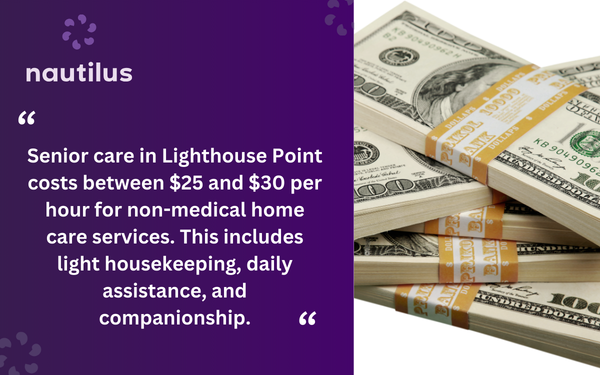
You can expect to pay $1,000 to $1,800 per month for 10 to 15 hours of support per week. Moderate support costs $2,500 to $3,600 per month, with 25 to 30 hours.

If seniors need full-time care, the cost totals to about $4,900 per month on average. The care plan includes about 44 hours per week.

24-hour care is another option for those needing constant assistance. The cost depends on the staffing needs.

Category Details Cost / Benefit
Hourly Cost Non-medical home care services including housekeeping and companionship $25 – $30 per hour
Light Support 10–15 hours per week of assistance $1,000 – $1,800 per month
Moderate Support 25–30 hours per week of care $2,500 – $3,600 per month
Full-Time Care Approx. 44 hours per week ~$4,900 per month
24-Hour Care Continuous supervision and support Varies based on staffing
Basic Services Meal prep, housekeeping, medication reminders Lower cost tier
Personal Care Bathing, dressing, grooming assistance Moderate cost
Specialized Care Dementia, chronic illness support Higher cost due to training
Scheduling Impact Weekends, nights, holidays increase rates Higher hourly pricing
Key Benefits Independence, emotional comfort, safety Improved well-being

​

Factors That Affect the Price of Senior Care

Level of Care

The level of care is related to the caregiver’s experience and certification. Basic companionship and light housekeeping are on the lower end of the price range.

Personal care, such as help with bathing and dressing, costs slightly more. The staff needs additional training to provide services safely and respectfully.

​

Specialized Care

Individuals with some chronic conditions require specialized care. This level of care requires trained caregivers. Since the agency covers training and certifications, this raises the hourly rate.

​

Schedule

Weekday daytime visits are on the lower end of the range. But if you have evenings, overnight shifts, weekends, or holidays in the care plan, the hourly rates are higher.

​

Why More Seniors Prefer Care at Home

For seniors, home is not only a place to live. It holds memories and routines, providing emotional comfort for them.

Moving to a facility is difficult for seniors. Leaving the place they called home for years is overwhelming. On the other hand, they will deal with a new environment, tight schedules, and unfamiliar faces. Adapting to the changes creates stress for them.

On the other hand, senior care adapts to their needs and routines. Caregivers provide support at the client’s home. This makes seniors feel safe and comfortable.

Staying in familiar surroundings helps seniors maintain strong emotional well-being. This helps reduce anxiety, which is especially important for individuals with cognitive decline.

​

What Senior Care Actually Looks Like

Senior care provides daily support and companionship. The goal is to support seniors in everyday life and encourage independence.

Professional caregiver help with:

  • Meal preparation
  • Light housekeeping
  • Medication reminders
  • Mobility assistance
  • Transportation
  • Personal care
  • Companionship and conversation

The most important aspect of senior care is that every care plan is adjusted to the client. The individual approach allows seniors to get the help they need without taking away their independence and dignity.

Some need a few hours of help per week. Others need daily visits or full-time care. The care plans can be adjusted according to the needs.

Margaret is a senior resident of Lighthouse Point. She lived independently for years after her husband passed. Her children live out of state.

Over time, they noticed subtle changes. Margaret sometimes forgot to take her medications. Also, she no longer felt confident driving. This made grocery shopping and going to the doctors more challenging.

Her family didn’t think assisted living was an option for her since she is still independent. So they decided to go for in-home care. They arrange three visits per week.

The caregiver did grocery shopping, medication reminders, and took the client to her appointments. The family felt reassured knowing someone was taking good care of her.

​

The Importance of Companionship for Seniors

Physical assistance is very important for seniors. However, we shouldn’t underestimate the power of emotional support. Loneliness and isolation are common problems for seniors. According to studies, these affect mental and physical health. Over time, social isolation leads to depression, anxiety, and cognitive decline.

Companionship is one of the services provided by in-home care agencies. Something simple like a conversation, sharing a meal, or a short walk is beneficial for them.

​

Personal Care with Dignity and Respect

As people age, their body doesn’t have the same physical strength. So they struggle with personal hygiene. Simple tasks such as bathing, dressing, and grooming become difficult to manage, especially for individuals with arthritis, mobility issues, or recovering from surgery.

Caregivers step in to provide support while maintaining dignity. They are respectful and make the whole experience more comfortable for seniors. They help clients feel less embarrassed about receiving help.

For families, having someone to help their loved one with personal care is important. The bathroom is a common location for accidents in the home. So the caregiver reduces the risk of falls and injuries.

​

Supporting Seniors with Memory Challenges

Seniors with Alzheimer’s or other forms of dementia have unique care needs. In the early stages, they forget about things. They may miss medication or forget about appointments.

Caregivers trained in memory care techniques provide the support they need. They set the structure and provide guidance while supervising the client.

Staying in a familiar environment is beneficial for individuals with memory challenges. This helps reduce confusion and anxiety.

Helping Families Balance Caregiving Responsibilities

Often, family members are the main caregivers. While they can provide the needed care at the early stages of the aging journey, things become more difficult as time passes. The responsibilities increase as a senior’s physical and cognitive abilities decline.

Over time, family members can experience burnout and stress. Many already have a full-time job, parenting duties, and personal responsibilities while managing caregiving.

Lighthouse Point senior care supports families with caregiving services. This allows family members to always spend quality time together. Also, they can take some time for recharging, child care, or taking care of their health.

For many families, having a helping hand makes a huge difference. They don’t carry the burden of being full-time caregivers. Instead, they provide emotional support.

​

Flexible Care

Flexibility is one of the greatest advantages of Lighthouse Point senior care. The individual’s needs change over time. The family members and agency work closely together to adjust schedules.

Many start with weekly companionship visits and add services or hours as needed. Families may realize their loved one needs help with transportation and errands, so they adjust the services.

A surgery, illness, or chronic condition changes the dynamics. The care plan changes to daily visits to provide the needed support.

​

Choosing the Right Lighthouse Point Senior Care Provider

Choosing the right care provider is an important decision. It affects the senior and the family. Don’t look only at the services, but also the quality and reliability.

​

Training and Qualifications

The caregiver’s training and experience are what matter the most. Reputable home agencies employ professionals with training in senior support.

Many caregivers have certifications such as Home Health Aide (HHA) or Certified Nursing Assistant (CNA). These certifications are common for senior care and home care. This means they have training in areas like personal care, safety procedures, and mobility assistance.

Some caregivers get training in dementia care, fall prevention, and emergency response. This way, the agency can be sure they meet your requirements.

​

Personalized Care Plan

Every person has unique needs, routines, and preferences. The right senior care provider should provide a personalized care plan.

The process starts with a consultation. The agency assesses the lifestyle, medical needs, and daily difficulties. Based on this, they create a care plan that provides the needed support.

Over time, circumstances can change. A recovery from illness means the senior will need less support. On the other hand, cognitive changes or reduced mobility will need more hours and services. And the agency should be flexible to accommodate that.

​

Communication

Families feel more comfortable when receiving regular updates. Reputable agencies maintain strong communication with the family, in-person or through digital channels. This is especially important for relatives who are out of state.

​

Final Take

Senior care allows aging with dignity and independence. Individuals can stay in the comfort of their own home for many years. And family members can take care of their responsibilities without guilt.

Everything starts with a consultation. Senior care providers respect the individual’s routines, preferences, and dignity. Contact us now to find out more!

Question Answer Notes
What services are included in senior care? Services include meal prep, housekeeping, medication reminders, transportation, and companionship Can be customized per individual
How much does senior care cost? Costs range from $25–$30/hour or $1,000–$4,900+ monthly depending on care level 24-hour care costs vary
Is in-home care better than assisted living? It depends on needs, but many prefer home care for comfort and independence Ideal for seniors who are still relatively independent
Can care plans change over time? Yes, care plans are flexible and adjust to evolving needs Families and providers coordinate updates
Do caregivers have certifications? Many caregivers are HHA or CNA certified with additional training Includes dementia care and safety training

In-Home Care in Sandalfoot Cove

Home care is more than just help around the house. In vibrant communities like Sandalfoot Cove, residents appreciate the social interactions too. They value staying close to the people they love and enjoy their familiar environment.

However, many families question whether it is safe for their loved ones to live at home. This guide provides more information on how in-home care in Sandalfoot Cove supports families and seniors.

Key Takeaways
  • In-home care allows seniors in Sandalfoot Cove to remain in familiar surroundings while receiving support with daily tasks.
  • Services range from companionship and housekeeping to personal care and memory support.
  • Caregivers help reduce fall risks, improve social interaction, and support emotional well-being.
  • Respite care gives family caregivers time to rest while ensuring their loved one continues receiving proper care.
  • Compared to assisted living or nursing homes, in-home care can be a more flexible and affordable solution depending on the hours of care needed.

​

Benefits of In-Home Care in Sandalfoot Cove

Emotional support

One of the caregiver’s main responsibilities is companionship. Many seniors struggle with isolation and loneliness. They may not have the energy to attend social events. While seniors can still be independent, many families arrange home care just for the social aspect.

For example, Mr. Joseph has early-stage Parkinson’s and lives alone in Sandalfoot Cove. After his wife passed, he became isolated. He can’t host the Sunday lunch with neighbors anymore due to declining physical health.

His daughter had heard about in-home care services and decided to give it a try. She arranged a caregiver for two afternoons a week. They encouraged Mr. Joseph to walk around the garden and had meaningful conversations about his grandchildren. These simple actions helped with his mental health.

​

Building independence

A family in Sandalfoot Cove struggled with care and work. Mrs. Martinez couldn’t keep up with housekeeping after a hip surgery.

The family members agreed to get a part-time caregiver. They helped with cooking, taking her to orthopedic appointments, and light housekeeping. This allowed Mrs. Martinez to recover safely at home. As she got back on her feet, the care plan was adjusted, and the hours were reduced.

Service Type What It Includes How It Helps Seniors
Companionship Conversation, playing board games, short walks, and transportation to social events. Reduces loneliness and provides emotional support while helping seniors stay socially engaged.
Personal Care Bathing, grooming, dressing, toileting assistance, mobility support, and medication reminders. Helps seniors safely manage daily activities while maintaining independence at home.
Light Housekeeping Laundry, vacuuming, mopping, cleaning kitchens and bathrooms, trash removal, and meal preparation. Maintains a clean, safe living space and reduces fall risks caused by clutter or slippery floors.
Respite Care Short-term caregiving that allows family members to take breaks from daily caregiving duties. Prevents caregiver burnout and provides peace of mind for families.
Cognitive Support Routine building, gentle redirection, wandering supervision, help with meals and hygiene, and memory-stimulating activities. Helps seniors with dementia or memory challenges remain safe and supported at home.

​

Types of in-home care available in Sandalfoot Cove

Home care services in Sandafloot Cove focus on supporting daily living. Caregivers provide personal care, light housekeeping, transportation, and companionship.

​

Companionship

Companionship is the starting point in most cases. This service is designed for seniors who are independent but need social interaction.

This includes:

  • Conversation
  • Playing board games or cards
  • Going for short walks
  • Transportation to social events

​

Families report that a few hours of companionship per week help improve their mood.

​

Personal care

When seniors struggle with mobility, personal care is one of the services they request. This is more involved than companionship and often includes:

  • Bathing and grooming
  • Dressing
  • Toileting assistance
  • Mobility support
  • Medication reminders

​

Clients request personal care assistance when struggling with mobility. The client wants to keep their independence but understands some daily tasks are not safe.

For example, a senior has had a fall and is afraid of falling again. The caregiver helps him step safely into the shower. This allows the client to maintain their independence while preventing another accident.

​

Light housekeeping

House chores can be a big challenge for seniors. Some struggle with mobility, while others tire easily.

This includes:

  • Laundry and linen changes
  • Vacuuming and mopping
  • Bathroom and kitchen cleaning
  • Trash removal
  • Organizing clutter to reduce fall risk
  • Meal planning and cooking

​

Falls are one of the common problems when older adults lose their independence. Caregivers help keep the walkways clear and floors dry to prevent accidents.

​

Supporting family caregivers

Sometimes, family members need a break from caregiving. They deal with full-time jobs, child care, and help their parents daily. As a result, burnout can occur.

Respite care is one of the most underused services in the area. It provides peace of mind for family members, giving them time to handle personal responsibilities.

​

Cognitive decline support

Home care agencies provide non-medical support for seniors with memory challenges. The caregivers need specific training and patience for this.

The services include:

  • Establishing predictable daily routines
  • Gentle redirection during confusion
  • Supervision to prevent wandering
  • Assistance with meals and hygiene
  • Structured activities to stimulate memory

​

Caregivers supervise clients with dementia or Alzheimer’s, allowing them to stay safe at home.

​

How much does in-home care cost in Sandalfoot Cove?

In-home care in Sandalfoot Cove costs from $22 to over $30 per hour. The total cost depends on the hours included, care type, and additional fees.

For example, personal care costs more than companionship. Also, specialized services such as dementia care cost more, since the license and training raise the price.

Simply put, there is no one-size-fits-all solution. Each care plan is shaped according to the client’s needs. If you want a clear idea of the total cost, contact your chosen home care agency.

​

Common challenges

Families have many concerns regarding home care. Some worry about the cost, while others think about how caregiver turnover impacts their loved one.

​

Caregiver turnover

High turnover disrupts the client’s routines. The job isn’t easy, and many leave because of high emotional burnout.

In most cases, families seek a good match rather than just the qualifications. Some choose to hire two caregivers for backup.

​

Scheduling conflicts

Home care is available to clients as needed. Families coordinate with the agency to create schedules. Caregivers provide early morning or evening support to match the family’s schedules.

​

Costs

One of the most concerning aspects is the cost of home care. Families are worried because Medicare often doesn’t cover home care. But families should consider other options. Veteran benefits and Florida programs provide help.

However, keep in mind that in-home care is more affordable than other options when the client is independent. Long-term facilities have a higher monthly cost.

Assisted living facilities cost $4,475 to $5,324 per month across Florida. The nursing home costs are even higher. Expect to pay $10,342 to $10,972 for a semi-private room, and $11,558 to $12,262+ for a private room.

On the other hand, home care costs between $2,000 and $5,000, depending on the hours included.

​

Why families in Sandafloot Cove prefer in-home care

When families explore care options, facilities are often out of the picture. Seniors prefer to age at home. They have lived in the same house for 20 or 30 years. So staying in a familiar environment means identity and control for them.

​

Familiar surroundings

Change is especially hard for seniors. And it is even more difficult for those suffering from mild cognitive decline. Living in their own house means the house layout is known.

The light switches are instinctive. And they can have a short conversation with the neighbors they know forever.

In fact, these small details reduce anxiety. For seniors with early dementia, a facility means confusion.

​

Encouraging independence

Seniors are afraid of losing their independence. Staying in a facility means they no longer enjoy the comfort of their home and their everyday routines.

However, home care works around their needs and preferences. The person can decide when they want to eat and what. They can watch their favorite TV show or sit outside. The caregiver provides the support and supervision where needed.

In facilities, the schedules are fixed. Meal times and activities are strictly planned. Seniors may feel like they lose independence, and this is one of the reasons why they resist facilities. Families in Sandalfoot Cove prefer their loved ones to feel like they own their lives.

​

Stronger family involvement

It is a common misunderstanding that in-home care replaces family care. In fact, it supports daily life so family members can engage in meaningful connections.

Adult children often live in Boca Raton, Delray Beach, or within Sandalfoot Cove. When the caregiver helps with daily activities, families have more time to provide emotional support. Instead of sorting medications and cleaning, they can view old photos and revive memories.

​

Lower emotional stress

Relocating to a facility is stressful for seniors. They need to adjust to communal living and sharing space with strangers. For someone who has lived in the same house for years, transition is difficult.

And the good news is that in-home care is flexible. It allows families to move gradually and get used to the change.

The care plan can start with a few hours per week. Then it can be increased as needed. Whereas, moving to a facility is not adaptable.

​

Managing safety

Safety is one of the common concerns when discussing home care in Sandalfoot Cove. However, the safety risks can be addressed with proper planning.

Families are worried about falls, wrongly taken medication, poor nutrition, and isolation. Caregivers can help prevent all of that. They supervise showers, keep walkways clear, maintain dry floors, cook healthy meals, and offer companionship.

For example, the caregiver can suggest that families add grab bars, remove loose rugs, and add lighting to improve safety.

​

Final take

In Sandalfoot Cove, in-home care is more than just a scope of services. It allows long-time residents to stay in the community they helped build. It supports family connections, as seniors can stay close to their loved ones.

Each visit becomes more meaningful, and conversations have emotional value when not interrupted by caregiving responsibilities.

For the ones who want to get started, the first step is to get in touch with your agency. Contact us now, and we will discuss your needs!

Frequently Asked Questions

What services are included in in-home care in Sandalfoot Cove?
In-home care services typically include companionship, personal care, light housekeeping, meal preparation, transportation, and support for seniors with memory challenges.

How much does in-home care cost in Sandalfoot Cove?
The average cost ranges from about $22 to $30 per hour depending on the level of care required. Total monthly costs vary based on the number of hours scheduled.

Is in-home care cheaper than assisted living?
In many cases, yes. Assisted living in Florida often costs between $4,475 and $5,324 per month, while nursing homes can exceed $10,000 monthly. In-home care costs vary depending on hours but may range from about $2,000 to $5,000 per month.

Can seniors with dementia receive care at home?
Yes. Many home care agencies provide caregivers trained to support seniors with dementia or Alzheimer’s through structured routines, supervision, and assistance with daily tasks.

Why do families choose in-home care instead of facilities?
Families often prefer in-home care because seniors can remain in familiar surroundings, maintain independence, and stay close to loved ones while still receiving needed assistance.

​

Hamptons at Boca Raton In-Home Care

In-home care has become a popular option for many families in the Hamptons at Boca Raton. The community consists of long-time residents and retirees who value the concept of aging in place.

# Key Takeaway Why It Matters
1 In-home care supports aging in place. Seniors remain in a familiar, comfortable environment.
2 Care plans are personalized and flexible. Services and hours adjust as needs change.
3 Costs typically range from $25–$30 per hour. Families can budget based on hourly needs.
4 Companionship is a core benefit. Reduces isolation and supports emotional well-being.
5 Agency selection impacts safety and reliability. Licensed and insured providers reduce liability and ensure quality.

In-home care brings the needed support to the comfort of their own home. Caregivers help with daily tasks and companionship, letting seniors enjoy their independence.

This guide explains more about Hamptons at Boca Raton in-home care. You’ll understand why families choose this option, how much it costs, and other details to help you make a decision.

​

Hamptons at Boca Raton in-home care

In-home care includes the non-medical services provided at the client’s home. It focuses on assisting with everyday activities, such as dressing, bathing, light housekeeping, transportation, and companionship. Home health care differs from in-home care, as it involves medical professionals.

Home care is tailored to the individual’s needs. The care plan includes hours and services as agreed.

That flexibility is the main reason home care is popular in the Hamptons. It is a balanced choice for local families that want to keep their loved ones comfortable.

Category Details Key Takeaway
What Is In-Home Care? Non-medical assistance at home including dressing, bathing, housekeeping, transportation, meal prep, and companionship. Supports independence while remaining at home.
Why Families Choose It Familiar environment, flexible scheduling, personalized care plans, emotional support, and safety monitoring. Promotes comfort, dignity, and peace of mind.
Cost Per Hour $25 – $30 per hour depending on level of care and provider. Flexible hourly structure allows budget control.
Estimated Weekly Cost 40 hours/week ranges from approximately $989 – $1,200. Part-time care is more affordable than facilities.
Estimated Monthly Cost $3,200 – $5,000+ depending on hours and care complexity. Costs increase with higher care needs.
Cost Factors Care type (companion vs personal/specialized), schedule, caregiver experience, weekends/holidays, agency vs private hire, duration. More complex or extended care raises total cost.
Agency vs Private Hire Agencies handle licensing, insurance, payroll, background checks, and backup staffing. Agencies offer reliability and reduced liability risk.
Choosing an Agency Verify licensing, insurance, caregiver training, trial visits, communication practices, and care plan flexibility. Transparency and compatibility are essential.

Why families in the Hamptons at Boca Raton choose in-home care

​

Familiarity and comfort

Seniors are often resistant to care facilities. They prefer to keep their dignity and independence. Some dislike the strict schedules, while others prefer to keep their routines. They appreciate waking up in their own bed and drinking coffee in their favorite cup.

We’ll take one of our clients as a great example. His daughter arranged for home care after a mild stroke, as he needs help with dressing and moving around the house. He has always been active in neighborhood events within the Hamptons at Boca Raton.

His family opted for home care in the morning and evening, rather than a facility. The senior still walks to the mailbox and greets the neighbors. This provides him with a feeling of comfort.

In fact, studies show that staying in a familiar environment can reduce stress and support emotional well-being.

​

Personalized care plan

Home care agencies are flexible when it comes to creating the care plan. The schedule is built around the person’s unique needs, making them feel seen and supported.

As the client’s health condition changes, the care plan evolves. For example, Mr. Steven decided to recover at home after a stroke. His family contacted our agency, and we worked together to create a care plan. The caregiver visited twice daily, providing mobility support, helping with speech exercises, and preparing meals.

After a few weeks, his condition improved, and the client regained their independence. The care plan was adjusted. The caregiver visits weekly, providing companionship and emotional support.

​

Safety

Safety and peace of mind are other reasons why families choose home care in the Hamptons at Boca Raton. Family members who live out of state feel reassured someone is taking care of their loved one.

The caregiver provides regular updates to family members. They can continue with their jobs and family life without worrying.

​

Companionship

Companionship is one of the overlooked aspects. Humans are social creatures, so isolation and loneliness take a toll on our mental health.  Hence, providing emotional support is as important as the practical tasks.

The caregiver establishes a meaningful connection with clients. They look forward to the visits not only because of the help. The simple conversations help reduce loneliness and boost their mood.

​

How much does in-home care cost in the Hamptons at Boca Raton?

The in-home care in the Hamptons at Boca Raton costs between $25 to $30 per hour. The price you pay depends on the level of support needed and the provider.

For a 40-hour work week, the cost would range between $989 and $1,200. For monthly support, that would be $3,200-$5,000, or more.

Hourly care is more affordable for individuals needing part-time help when compared to assisted living or facilities. Families can adjust the hourly schedule as needed.

When planning home care, discuss all the aspects with your provider. Talk about cost, schedules, and responsibilities to know what to expect.

​

Factors affecting the cost

Care type

The type of support required is a major factor that impacts the price. Companion care is usually at the lower end of the range.

On the other hand, personal care services cost more. Things like bathing, dressing, toileting assistance, and mobility help require additional training and responsibility.

Special care services, such as dementia or Parkinson’s support, are priced higher due to experience, training, and safety risk involved.

For example, a client who only needs help with meal prepping and grocery shopping three times a week pays less. Someone requiring two caregivers for mobility support will pay more.

​

Schedule

In-home care provides flexibility, which affects the pricing. Part-time, 24/7, and live-in care are the available options.

The more hours your weekly care plan has, the higher the total cost. Still, some providers may slightly lower rates for long-term arrangements.

​

Caregiver experience and skills

Caregivers are assigned based on the client’s needs. If your loved one needs memory care, post-stroke mobility support, or fall prevention, experienced caregivers cost more.

​

Weekend and holiday rates

Rates are higher for nights, weekends, and major holidays. If your schedule includes overnight support or holiday coverage, the fees will be higher.

​

Agency vs. private hire

Some families consider hiring a caregiver privately to save money. This way, they achieve a lower hourly rate.

However, the family will be responsible for payroll taxes, compensation, liability insurance, and backup if the caregiver calls out. Agencies charge more because they handle all of that. The provider handles logistics and replacement caregivers, and the reliability is worth the extra cost.

​

Duration of care

Home care can be either long-term and short-term. And the duration of care determines the price.

Clients often request short-term care to cover post-surgery recovery. It lasts for a couple of weeks or until the patient regains their independence. This type of arrangement costs more. Agencies may require minimum hours for short-term contracts.

As previously mentioned, long-term clients may get slightly reduced rates. They receive stable pricing with consistent schedules.

​

How to choose the right in-home care agency

Florida’s in-home care market is growing. The large aging population and aging-in-place habits are responsible for this trend.

Thanks to the high demand, there are a lot of in-home care agencies in the Hamptons at Boca Raton. However, not all of them operate the same. We share some practical tips to help you evaluate the providers and make the right choice.

​

Experience and training

Professional agencies do background checks and ensure their caregivers are licensed. The Florida Department of Health and AHCA (Agency for Health Care Administration) are responsible for regulating this industry.

Make sure the agency is licensed and that they have liability insurance. If they don’t have the insurance, the homeowner is liable in case the caregiver gets injured.

Don’t feel embarrassed to ask any questions you have. Reputable agencies understand that this is your first time looking for in-home care and will provide the answers you need.

​

Trial visit

A trial visit helps you understand if the caregiver is the right choice for taking care of your loved one. Compatibility is also important, not only the skills. After all, the caregiver is in your private space, and you want your loved one to feel comfortable.

Ask your agency about how they match caregivers to clients. Also, ask whether you can request a different one if the first one is not a good match.

​

Communication and transparency

Clear communication is crucial during the process. Find out who will be your main point of contact and how often updates are provided. This is even more important for family members living out of state.

​

Care plan process

The care plan evolves over time. The provider should explain how the plans are created and how often the reviews are conducted. Ask about how flexible they are if needs increase and hours need to be adjusted.

​

Final take

Home care in the Hamptons at Boca Raton is more than just care services. It is a way to bring love and support to the lives of seniors. Family members have peace of mind knowing their loved one is enjoying their community while getting the support they need.

Making a final decision isn’t easy for families. The first step is to get in touch with a reputable home care agency and learn about the process. Contact us now, and we will be happy to assist!

Question Answer Quick Insight
What services are included in in-home care? Non-medical services such as bathing, dressing, meal preparation, housekeeping, transportation, and companionship. Focuses on daily living support.
How much does in-home care cost in the Hamptons at Boca Raton? Typically between $25 and $30 per hour, depending on care needs and provider. Costs vary based on complexity and hours.
Is in-home care more affordable than assisted living? For part-time needs, hourly home care is often more affordable than facility-based care. Best for seniors needing flexible support.
Can care plans change over time? Yes. Care plans are reviewed and adjusted as health conditions or needs evolve. Flexibility is a major benefit.
What should families look for in an agency? Licensing, insurance, caregiver training, background checks, trial visits, and clear communication. Transparency ensures peace of mind.
  • « Go to Previous Page
  • Page 1
  • Page 2
  • Page 3
  • Page 4
  • Page 5
  • Interim pages omitted …
  • Page 15
  • Go to Next Page »

© Nautilus Homecare All Right Reserved. Privacy Policy.

Location

2061 NW 2nd Ave., Ste 203
Boca Raton, FL 33431 
LIC#NR30211080

Phone

561.637.4242

Email

info@nautilusshc.com

Available to speak 24/7

Home
Services
About
FAQs
Blog
Careers
Contact