


Family members aren’t always prepared for a crisis. Chronic conditions can get worse suddenly. A fall not only impacts the emotional well-being but also the schedule of everyone. And hospital discharge requires care to avoid readmissions.
Family caregivers can experience burnout. Or they have other emergencies to attend to. This raises the question of quick access to in-home care.
This article explains more about the time needed to start in-home care services. You’ll understand the factors that affect the timeline, as well as the things on your end that can speed up the process.
| Key Takeaway | Why It Matters |
|---|---|
| In-home care can start within 24–72 hours. | Rapid response agencies can act quickly during urgent situations. |
| Private pay arrangements move fastest. | Insurance and benefits programs may require approval time. |
| Clear communication speeds up caregiver matching. | Detailed information prevents last-minute changes and delays. |
| Complex cases require experienced caregivers. | Proper matching ensures safety and quality of care. |
| Flexibility helps care begin sooner. | Strict caregiver preferences may limit availability during emergencies. |
Can in-home care start quickly in an emergency?
In-home care can start quickly in an emergency. In some cases, it is available within 24 to 48 hours or less.
The start of in-home care depends on a few factors:
- Availability of caregivers
- Type of care needed
- Paperwork
- Funding source
- How clearly the family can communicate the situation
If a home care agency has available caregivers that suit your specific needs, this is a good start.
| Category | Key Details | Impact on Timeline |
|---|---|---|
| Emergency Start Time | Care can often begin within 24–72 hours; some agencies respond within 24–48 hours. | Faster if caregivers are available and needs are clearly defined. |
| Factors That Speed Up Care | Clear communication, discharge paperwork ready, private pay, flexible caregiver preferences. | Reduces administrative and matching delays. |
| Common Emergency Situations | Hospital discharge, falls, cognitive decline, caregiver burnout, new diagnoses. | Often require support within days. |
| Care Type | Non-medical care (bathing, dressing, cooking, supervision) starts faster than complex cases. | Specialized or behavioral cases require experienced caregivers. |
| Funding Source | Private pay moves fastest; insurance, Medicaid, veterans benefits may require approval. | Insurance approvals can delay services. |
| Common Delays | Limited staffing, holidays, rural areas, flu season, extreme weather. | May require schedule rearrangement or new hires. |
| Complex Cases | Severe dementia, aggression, mobility lifting needs. | Caregiver matching takes longer for safety reasons. |
| 24-Hour Care Requests | Requires 2–3 rotating caregivers and backup staff. | May take 48–72 hours to fully coordinate. |
| Administrative Requirements | Insurance verification, documentation, compliance rules. | Some processes only occur during business hours. |
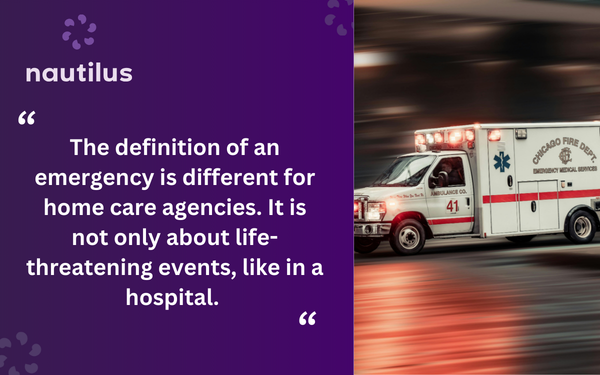
The definition of an emergency is different for home care agencies. It is not only about life-threatening events, like in a hospital. An emergency means the client needs assistance and can’t be left alone. Common situations include:
- Limited mobility after hospital discharge
- A fall that means increased safety risk
- Progressing cognitive decline
- Sudan’s unavailability of family caregivers
- Progressing chronic conditions
- New diagnosis that requires medication management and supervision
These are some of the examples where families need support. More importantly, they need it within days.
How quickly can in-home care begin?
In-home care agencies can provide services within 24-72 hours in most cases. This includes non-medical care such as bathing, dressing, cooking, and supervision. However, this depends on the caregiver’s availability, clearly defined services, and payment arrangements.
Many agencies specialize in rapid response calls. This means they can arrange help in 24 hours.
How to speed up the process
How quickly you get home care depends on many factors. Clear communication is one of the things that you have full control of.
Many families feel overwhelmed after an emergency. So they forget about some details, which can postpone the process.
In addition, we share a list you can follow for reference.
Describe the needs
The in-home care agencies need details about the client’s needs. They work together with you to create a care plan that suits their requirements. So sharing the correct information in the first place prevents last-minute changes. Hence, the client can be matched with the caregiver with the proper experience.
Here are some questions you can expect:
- Is assistance needed for mobility?
- Is the client continent?
- Is dementia involved?
- Are there aggressive behaviors?
- Is lifting required?
Hospital discharge paperwork
If hospitalization is included, you need to have the discharge paperwork ready. Having the care instructions and discharge summaries available will speed up the process.
Funding
Private pay arrangements move the fastest. With long-term care insurance, Medicaid waiver programs, and veterans benefits, the approval time can vary.
In fact, some agencies may proceed with service before the paperwork is completed.
Flexibility
Families that request a specific personality match in a caregiver may wait longer. If there’s flexibility in caregiver requirements, the service can start faster.
What slows emergency home care down
While families face difficulties, agencies also have constraints that prevent them from acting fast. Staffing availability, regulations, safety, and documentation are some of the things that can slow home care down.
In addition, we get into the reasons and share some real-life examples.
Limited caregiver availability
Staffing is the biggest problem that causes the delays. Agencies may have limited staff in busy areas and during the flu season.
In reality, home care agencies do not have caregivers on standby. The available employees are scheduled for active clients. When the family contacts the agency during an emergency, they will have to rearrange schedules or hire more staff, which takes time.
For example, the son calls to get home care. His father was discharged after a hip surgery and needs assistance with mobility, toileting, and medication management.
The agency can assign caregivers during the weekdays, but has no availability for weekend overnights. This happens because the weekend is already arranged with other clients.
Hence, the agency needs some time to adjust and organize its work.
Some factors that make things harder:
- Rural locations
- Holiday weekends
- Flu season
- Extreme weather
- Complex cases require experienced caregivers
- 24/7 coverage requests, where multiple caregivers are needed
Unsafe home environment
Unsafe home environments are another reason for delaying care. This poses risks for the client and caregiver. Serious hazards like hoarding, broken stairs, or no running water require modifications.
The agency will assess the conditions and determine the need for changes. This protects the client and staff.
Complex cases
If a client has a complex health condition, this requires experienced caregivers. Severe dementia, aggression, and behavioral concerns must be matched to the skilled staff. Otherwise, safety is compromised.
For instance, a daughter calls an agency to request home care for her mother with Alzheimer’s. She began wandering at night and resisted bathing. The agency looks for caregivers with dementia training and experience in behavioral management. This can take some time, but it is needed to ensure safety.
For agencies, delivering quality service is a priority. So they won’t rush the caregiver matching. Otherwise, it ends up with caregiver dissatisfaction, family dissatisfaction, risks, and neglected needs.
For complex conditions, the right match is more important than a fast start.
Insurance delays
Services can start faster with private pay. But with other programs such as veterans benefits, long-term care insurance, and Medicare home health, additional approvals might be needed. These postpone the whole process. In some cases, agencies can arrange temporary private pay until the documentation issues are resolved.
We understand that the administrative work feels frustrating for families. However, agencies must comply with the rules.
Family disagreement
Family members might not agree on the next steps. For instance, one sibling wants long-term care, and the other believes it would be expensive. Or, the client refuses help from outside.
In such cases, legal clarification can delay the start.
Requirements
Unrealistic expectations often slow the process. While done unintentionally, having specific criteria narrows down the choice of caregivers. Some prefer that the staff speak a certain language. Others want the same caregiver for every shift.
Having preferences is valid. But during emergencies, staying flexible ensures you get the services as soon as possible.
24-hour care
Families might not understand how staffing works for nonstop care. Basically, two or three caregivers will do rotating shifts. The company needs to arrange backup staff in case of illness. In addition, they need to follow the legal requirements such as labor laws and rest periods.
Doing all of this takes time. For example, a patient needs 24-hour support. The agency can offer daytime care immediately, but needs 48-72 hours to find caregivers to cover the shifts.
Holidays and weekends
When it comes to agencies, they’re ready to start the care on weekends. However, some administrative processes like insurance verification can be done only during business hours.
What happens when requesting emergency care
Phone consultation
The process starts with a brief discussion of the needs. The agency needs to know about the current situation, so feel free to share all the details. For some, detailed questions might sound intrusive. But remember that the coordinator is trying to understand the situation and determine staffing requirements.
Assistance needs
The coordinator wants to understand what type of help the client needs. Some need supervision and support, while others need full help. In-home care provides non-medical services like bathing, light housekeeping, toileting support, mobility, and transportation.
Mobility is one of the safety factors. Specify whether the client can walk independently, needs help, or has fallen recently. When heavy lifting is involved, the agency needs to assign a caregiver who is physically capable and has safe transfer training.
Knowing the specific needs, the agency can assign the right caregiver.
Final take
As a home care agency, we understand the challenges. Providers do their best to speed up the process, but some things are out of their control. Compliance, staff availability, lack of information or strict requirements regarding the caregiver can delay the start.
For families, it is important to stay prepared. And if you have any questions, feel free to ask. Contact us now, and we will discuss caregiver availability with you.
| Question | Answer |
|---|---|
| Can in-home care start the same day? | Some agencies may offer same-day service, but most emergency care begins within 24–48 hours depending on availability. |
| What documents are needed after hospital discharge? | Discharge summaries and care instructions help agencies quickly create a safe care plan. |
| Does insurance delay emergency home care? | Yes, insurance approvals, Medicaid waivers, and veterans benefits may require additional processing time. |
| Why does 24-hour care take longer to arrange? | It requires multiple rotating caregivers, backup staff, and compliance with labor laws. |
| What can families do to speed up the process? | Provide detailed care needs, prepare paperwork, confirm payment method, and remain flexible with caregiver preferences. |