


Deciding about home care comes with many challenges. It is not only about the schedule and budget, but it is also about safety, dignity, and peace of mind. When looking into home care, one of the most common questions is whether part-time or full-time support is needed.
Every person is different. And the home care plan isn’t one-size-fits-all. The right decision depends on practical needs, health conditions, level of independence, family dynamics, and personality.
| # | Key Takeaway |
|---|---|
| 1 | Part-time care is ideal for seniors who are mostly independent but need occasional help. |
| 2 | Full-time care provides continuous supervision and is best for complex health or mobility issues. |
| 3 | Cognitive conditions like dementia often require full-time care for safety. |
| 4 | Safety risks such as falls, missed medications, or wandering indicate a need for more care hours. |
| 5 | Family availability plays a major role—limited support increases the need for full-time care. |
| 6 | Part-time care is more affordable, but costs rise quickly as hours increase. |
| 7 | Full-time care can reduce indirect costs like hospital visits and caregiver burnout. |
| 8 | Care needs often evolve, so starting part-time and scaling up is common. |
Understanding What Part-Time vs. Full-Time Care Really Means
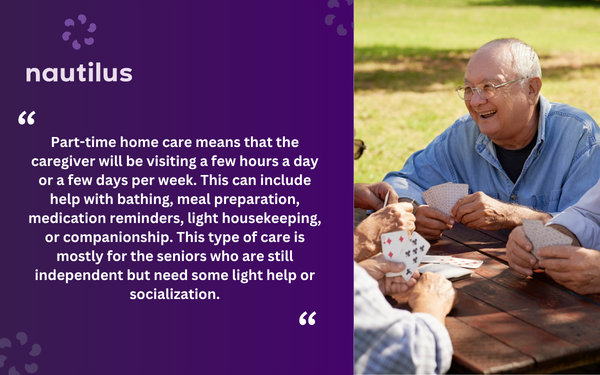
Part-time home care means that the caregiver will be visiting a few hours a day or a few days per week. This can include help with bathing, meal preparation, medication reminders, light housekeeping, or companionship. This type of care is mostly for the seniors who are still independent but need some light help or socialization.
Full-time care means consistent daily support. It is often 8 to 12 hours, or 24-hour care. This type of care is continuous, covering routine needs and unexpected situations. It is intended for seniors with complex health conditions.
| Aspect | Part-Time Care | Full-Time Care |
|---|---|---|
| Definition | Caregiver visits a few hours per day or week | Continuous daily support (8–24 hours) |
| Best For | Independent seniors needing light help | Seniors with complex health or mobility issues |
| Level of Assistance | Help with meals, bathing, medication reminders | Ongoing help with daily tasks and emergencies |
| Supervision | Limited supervision during scheduled hours | Continuous supervision and monitoring |
| Cognitive Conditions | May not be sufficient for dementia or Alzheimer’s | Recommended for memory loss and safety concerns |
| Safety | Gaps in coverage may leave risks | Ensures consistent safety and fall prevention |
| Routine & Stability | Fragmented routines | Structured and predictable daily routine |
| Family Involvement | Requires more family support | Reduces caregiver burden and burnout |
| Cost (Florida Example) | $1,600–$2,400/month (~20 hrs/week) | $4,000–$4,500/month (~44 hrs/week) |
| Flexibility | Easier to start and adjust gradually | More structured but less flexible |
Start With the Level of Daily Assistance Needed
How much help does your loved one actually need? consider their needs over a full 24-hour period, not just their best moments. If they can manage most activities but struggle with a few, part-time care can be enough. For example, they may need help preparing meals and showering, but can manage the rest.
The caregiver can visit for two hours per day to help with breakfast, personal care, and medication reminders.
However, things change when the needs become more frequent. When a senior needs mobility assistance and supervision, they need more hours of care.
For example, a family arranged three hours of home care each afternoon for their father. The caregiver prepared meals and provided companionship.
As his Parkinson’s symptoms worsened, he started having mobility issues. They needed help multiple times a day, including early morning and evening.
The family couldn’t keep up with care. They shared this with the care coordinator and transitioned to full-time care. This helps provide consistent help and peace of mind for the family.
Consider Cognitive Health and Supervision Needs
Cognitive conditions like dementia or Alzheimer’s often require a different level of care. Individuals with memory loss may be physically capable. But they need supervision to remain safe.
These conditions are often associated with wandering, forgetting to turn off the stove, or missing medications. Part-time care leaves long periods where the person is without supervision. As a result, full-time home care would be the best option.
For example, a woman with early-stage dementia had a caregiver for four hours a day. During those hours, everything went smoothly. She was supervised and safe. However, she began leaving the house in the evening. Her family decided it was time for full-time care to ensure continuous supervision to reduce risks.
When cognitive decline is the concern, families are often advised to go for full-time care.
Evaluate Safety Risks in the Home
Safety concerns in the home can be a strong indicator that full-time care is needed. First, assess the risk of falls and how safely they can move around the house alone.
Next, you need to consider whether they take their medication correctly. Lastly, leaving appliances on or doors unlocked are safety hazards to monitor.
If these signs are present, full-time care helps ensure safety. Part-time home care provides coverage only during certain hours.
Look at the Emotional and Social Impact
Some seniors value independence, so they may resist full-time care. In these cases, it is better to start with part-time support. This is more acceptable for them, and the support can increase gradually over time.
However, many seniors feel isolated. So they will benefit from consistent companionship.
Assess Family Availability
Many rely on family members as caregivers. However, they should understand how much support family members can realistically provide. They often start with part-time care and handle the rest by themselves.
Support starts with grocery shopping or taking the senior to doctor appointments. As the individual’s needs change, a higher level of care is needed. Daily supervision, medication management, and emotional support now take more time.
Family members may be living in another state. Or they can have full-time jobs and child care. By the time they look into full-time care, they’re already overwhelmed. Caregiver burnout happens gradually. Missed work, disrupted sleep, and constant worry begin to build up.
Switching to full-time care provides families with the relief they often need. This doesn’t mean they won’t stay involved.. They can take care of themselves and their responsibilities while providing emotional support.
Factor in Cost
The cost of in-home care is an important factor when choosing the right option. However, families should not only look at the numbers. They should pay attention to the value.
Part-time care is more affordable. You pay on an hourly basis, which is practical for families.
However, full-time care costs more. As more hours are added, the price goes up. But there is more to that. Families should look at the bigger picture when assessing their options.
Missed work hours for family members mean less money. Emergency situations and hospital admissions due to a lack of supervision also bring additional costs.
Cost of In-Home Care
Home care in Florida costs between $22 and $30 per hour. Various factors impact the price, such as level of care, location, and specialized needs.
Part-time care with about 20 hours per week costs between $1,600 and $2,400 per month. Full-time care with 44 hours per week costs between $4,000 and $4,500 per month. Specialized support, such as dementia care, mobility assistance, or post-surgical recovery, costs more.
It is important to understand what you’re paying for. In-home care is highly personalized, providing one-on-one assistance. At the same time, staff support multiple residents in a facility. While this allows flexibility, the costs rise as the hours increase.
When compared to other options, the difference is clear. Assisted living costs about $4,750 per month. This includes housing, meals, and shared caregivers.
Nursing homes cost between $10,300 and $11,500 or more for a semi-private room. They provide constant medical supervision, so the price is higher.
Part-time care is the most affordable option. But the costs rise quickly if care needs increase. Families often start with a few hours per day and gradually add more hours.
There are also indirect costs to consider. Family members may adjust working schedules or take unpaid time off to provide care for their loved one.
Pay Attention to How Needs Are Changing
When the health condition is stable, part-time care is enough. But keep in mind that needs change over time. In case of progressive illness or noticeable decline, the care schedule needs to be adapted.
Some signs that your loved one needs more support:
- Increasing falls or mobility issues
- Missed medications
- Confusion
- Weight loss or poor nutrition
- Growing anxiety when alone
- More frequent calls for help
The Role of Routine and Predictability
For seniors, routine means stability. This helps decrease anxiety and improve cooperation with care.
Caregivers help seniors with their daily routines. With part-time care, routines feel fragmented. They come at a certain time of the day, help with essential tasks, and leave. The rest of the day depends on whether the senior has a sense of structure.
For seniors who are independent, this isn’t an issue. But for others, gaps in routine can feel disorienting.
Full-time care helps create continuity in routines. The meals, medications, and daily activities are managed regularly.
Final Take
Choosing between part-time and full-time in-home care is about what fits the current situation. Part-time works well when the senior is independent and support needs are limited. The situation is predictable, and the family members are present to help outside of the care hours. It is a great starting point for seniors who want to maintain independence.
On the other hand, full-time care becomes a better choice when safety, supervision, or daily assistance needs increase. This helps reduce risks and provides consistency.
In many cases, families start with part-time care and take things from there. The goal is to improve seniors’ quality of life.
If you aren’t sure of the right choice, contact us now. With extensive experience in home care, we can help.
| Question | Answer |
|---|---|
| How do I know if part-time care is enough? | If the senior can manage most daily activities independently and only needs help with specific tasks, part-time care is usually sufficient. |
| When should I switch to full-time care? | Consider full-time care when safety risks, cognitive decline, or frequent assistance needs increase. |
| Is full-time care only for severe conditions? | No, it is also helpful for moderate conditions where supervision and consistency are needed throughout the day. |
| What are the biggest safety concerns at home? | Falls, missed medications, leaving appliances on, and wandering are major risks. |
| Is part-time care more cost-effective? | Yes initially, but costs can rise as more hours are needed over time. |
| Can families combine care with their own support? | Yes, many families start with part-time care and supplement with their own involvement. |
| Does full-time care reduce caregiver stress? | Yes, it helps reduce burnout by providing consistent professional support. |
| Can care plans change over time? | Absolutely, care plans should adapt as health conditions and needs evolve. |